



Quick Facts:
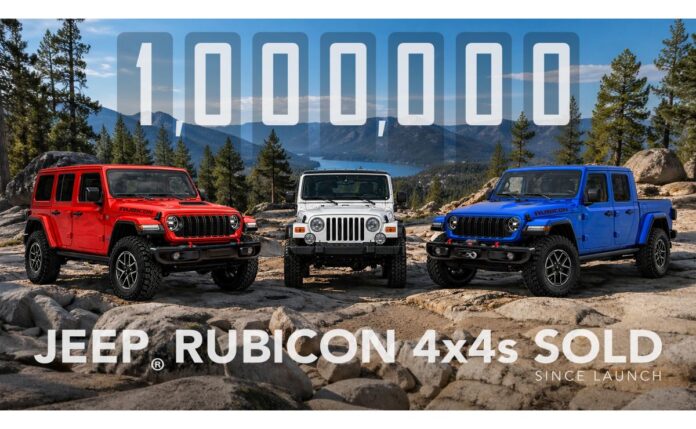
- The Jeep Wrangler Rubicon and Gladiator Rubicon hit 1,000,000 units sold globally as of April 29, 2026.
- Jeep announced the milestone from its Auburn Hills, Michigan headquarters.
- The Rubicon trim first appeared on the Wrangler in 2003, more than 22 years ago.
- A small group of Jeep engineers known as the Lunatic Fringe developed the original Rubicon using their own credit cards.
- Standard hardware includes Tru-Lok front and rear lockers, a Rock-Trac 4:1 transfer case, and 35-inch tire capability.
- The Wrangler Rubicon currently holds the title of America’s best-selling open-air vehicle.
Read time 9 min
In This Article
- The One-Million Milestone in Context
- Rubicon Milestone Key Numbers
- How the Lunatic Fringe Built the First Rubicon
- What Sets a Rubicon Apart
- Wrangler Rubicon vs. Gladiator Rubicon
- A Four-Jeep Owner’s Take
- The Trail Culture Behind the Sales Number
- Limited-Run Editions Marking the Milestone
- What One Million Says About Off-Road Demand
- Frequently Asked Questions
The One-Million Milestone in Context
The Jeep Wrangler Rubicon hit one million global units sold on April 29, 2026, a milestone Jeep announced from its headquarters in Auburn Hills, Michigan. Specifically, the figure covers Rubicon-badged Wranglers and Gladiators sold worldwide since the trim first appeared in 2003. For context, the average works out to roughly 43,500 Rubicons sold every year for 23 straight years.
The number is meaningful because the Rubicon is not a styling package. Instead, every Rubicon ships with hardware engineered for trail use most production SUVs will not survive. Consequently, one million buyers paid the premium for purpose-built off-road equipment, which signals where demand sits in 2026.
Jeep CEO Bob Broderdorf credited Rubicon owners and the global off-road community for shaping the trim’s legacy over more than two decades. He pointed to the trail riders who push the vehicles past their factory limits as the people who keep the engineering team honest year after year.
Rubicon Milestone Key Numbers
| Data Point | Detail |
|---|---|
| Total units sold globally | 1,000,000 |
| Milestone announcement date | April 29, 2026 |
| First Rubicon model year | 2003 (Wrangler) |
| Years of production | 23 (and counting) |
| Average annual sales | Roughly 43,500 units per year |
| Wrangler Rubicon max towing | 5,000 lb |
| Gladiator Rubicon max towing | 7,700 lb |
| Gladiator Rubicon max payload | 1,720 lb |
| Factory tire size capability | Up to 35 inches |
| Transfer case low range | Rock-Trac 4:1 |
How the Lunatic Fringe Built the First Rubicon
Before the Rubicon was a nameplate, it was a side project. A small group of Jeep engineers, internally known as the Lunatic Fringe, set out to build the most capable Wrangler the factory had ever produced. They funded prototype parts on personal credit cards because the official program budget did not exist yet.
What they delivered in 2003 redefined the meaning of factory off-road capability. The first Jeep Wrangler Rubicon shipped with Tru-Lok electronic locking differentials front and rear, a Rock-Trac transfer case running a 4:1 low range, and heavy-duty underbody armor. Notably, no mainstream production SUV at the time offered the same combination as standard equipment. As a result, buyers no longer needed to source aftermarket lockers or skid plates to take a stock Wrangler down a serious trail.
Because Jeep bundled lockers and armor into base Rubicon specs instead of option packs, competitors had no playbook to match the price. In addition, the choice created a customer base which has bought roughly one million Rubicons since.
What Sets a Rubicon Apart
The Rubicon name comes from the Rubicon Trail in California’s Sierra Nevada, one of the most punishing off-road routes in the United States. Jeep named the trim after the trail to signal its purpose: factory-ready hardware for terrain most SUV buyers will never attempt.
Every current Jeep Wrangler Rubicon and Gladiator Rubicon ships with a specific equipment list. First, front and rear electronic locking differentials sit at the core, paired with a Rock-Trac transfer case offering a 4:1 low-range crawl ratio. Next, Off-Road+ drive mode adapts traction control to deep sand or technical rock. In addition, Selec-Speed Control adds sand and stuck-recovery functions, letting you set a low crawl speed and focus on steering rather than throttle modulation.
One signature Rubicon trick is the ability to engage the lockers in high-range four-wheel drive. However, most lockers only operate in low range, which limits your speed across a sand wash or fire road. Finally, available WARN winches and 35-inch tire fitments round out the factory package, so you have less reason to rebuild the truck in the aftermarket.
Wrangler Rubicon vs. Gladiator Rubicon: Two Paths to the Same DNA
Both vehicles share the same off-road hardware, yet they answer different questions. The Jeep Wrangler Rubicon currently holds the title of America’s best-selling open-air vehicle and offers a best-in-class crawl ratio for technical rock work. In addition, it tows up to 5,000 pounds, which covers a small camper or a pair of adventure motorcycles on a trailer.
The Gladiator Rubicon, by contrast, extends the formula into pickup territory. Notably, it tows up to 7,700 pounds and carries up to 1,720 pounds of payload, making it the only Trail Rated pickup truck currently in production. For overlanders running rooftop tents, drawer systems, and a fridge, the payload number matters more than the Wrangler’s tighter approach angle. In addition, the bed solves a gear storage problem Wrangler owners spend money trying to solve with cargo cages and tailgate tables.
If you primarily rock crawl and want the shortest possible wheelbase, the two-door Wrangler Rubicon still wins. However, for overlanders who camp, haul, or carry tools, the Gladiator Rubicon answers more of the questions you have.
A Four-Jeep Owner’s Take on the Milestone
Personally, I have owned four Jeeps over the years, including a Gladiator Rubicon I drove for four seasons of overlanding and recovery work. The Gladiator’s combination of factory lockers, Rock-Trac low range, and bed payload solved problems I previously had to address with aftermarket parts on my older Jeeps. As a result, I never once had to question whether the truck would clear an obstacle the trail rating suggested it should.
I documented the entire ownership experience, including the mods, the problems, and the comparison against the Chevy Colorado ZR2 and the new Toyota Tacoma, in my four-year review video below.
What the one-million sales figure confirms for me is something I noticed every time I parked at a trailhead in the Sierra or near Big Bear. The lot was full of Rubicons. Not Saharas dressed up to look like Rubicons. Instead, actual Rubicon trims with lockers engaged, low range selected, and tires aired down. People are buying the trim for the purpose Jeep designed it for, and they keep buying it because the engineering still holds up against newer competitors.
Since then, I have moved to a 2025 Chevy Colorado ZR2 for daily and overland duty, and the platform comparison is informative. While the ZR2 brings DSSV shocks and a different chassis philosophy, the Rubicon’s locker behavior and crawl ratio remain a benchmark the segment measures itself against.
The Trail Culture Behind the Sales Number
One million Rubicons is not only a sales statistic, it is also a measure of community size. For example, events like the Easter Jeep Safari in Moab, Utah draw thousands of Wrangler and Gladiator owners every spring. In addition, trail clubs, regional convoys, and online owner forums keep the culture active in the months between major events.
The reason this matters for the milestone is simple. A vehicle which sells in volume only because it looks rugged eventually loses its position when trends shift. By contrast, a vehicle which sells because owners use it as designed, then bring friends into the segment, builds a customer base which survives styling cycles. Notably, the Rubicon has been doing the second thing for two decades.
For buyers researching their first capable off-road SUV, this community depth becomes a practical advantage. You will find local trail leaders, vetted shops, and modification advice for any Rubicon model year, often inside fifteen minutes of online searching. Specifically, the support shortens the learning curve for new owners.
Limited-Run Editions Marking the Milestone
Jeep is marking the one-million figure with a yearlong series of limited-run models through its Twelve 4 Twelve and Convoy product-drop programs. For example, recent editions include Whitecap and Rockslide trims for both Wrangler and Gladiator, alongside a Shadow Ops Rubicon variant for the Gladiator. The releases are positioned to showcase how the Rubicon platform handles different use cases, from cold-weather builds to truck-bed-focused expedition rigs.
Collectors tend to favor these limited editions over mainstream Rubicon trims, especially when production numbers stay below a few thousand units. For instance, the Trail Hunt Edition Wrangler Jeep released in Korea earlier this year capped at 20 units priced at $71,800 with $9,940 in Mopar accessories. Similarly, other small-batch releases are part of what is keeping enthusiast interest hot during the milestone year.
What One Million Says About Off-Road Demand
Selling one million purpose-built off-road vehicles in 23 years tells you something the rest of the SUV market does not want to admit. Buyers will pay a premium for engineering which survives terrain, even when crossover competitors offer more cargo space and better fuel economy at lower prices. As a result, the Rubicon premium has always been a bet on capability holding value longer than convenience features, and one million buyers have agreed.
For 2026 buyers cross-shopping the Jeep Wrangler Rubicon against newer entries, the milestone is also a reminder of platform maturity. Twenty-three years of production means most of the engineering kinks have been worked out, parts availability is broad, and the aftermarket support is the deepest in the segment. Compared to more recent capable trucks, the 2026 Wrangler Rubicon still leads on approach angle at 43.9 degrees and departure at 37.0 degrees.
Finally, the next milestone watch is whether the Rubicon platform will sustain its position as electrification reshapes the segment. Notably, the 4xe variant already hints at the direction. Either way, one million units is a number competitors will spend the next decade trying to catch.
Frequently Asked Questions
When did Jeep announce the Rubicon one million sales milestone?
Jeep announced the milestone on April 29, 2026, from its Auburn Hills, Michigan headquarters. The figure covers Wrangler Rubicon and Gladiator Rubicon units sold globally since the trim first appeared in 2003.
What year did the Jeep Wrangler Rubicon first launch?
The Rubicon trim launched on the Wrangler in 2003. Notably, a small Jeep engineering team known as the Lunatic Fringe developed it, funding early prototype hardware on personal credit cards before the program received an official budget.
What is the difference between a Rubicon and a regular Wrangler?
A Rubicon comes from the factory with Tru-Lok electronic locking differentials front and rear, a Rock-Trac transfer case with 4:1 low range, heavy-duty axles, off-road-tuned shocks, and the ability to engage lockers in high-range four-wheel drive. By contrast, Sport, Sahara, and Willys trims do not include these features as base equipment.
How is a Gladiator Rubicon different from a Wrangler Rubicon?
The Gladiator Rubicon shares the Wrangler Rubicon’s lockers, transfer case, and Off-Road+ tuning, then adds a pickup bed. As a result, it tows up to 7,700 pounds and is the only Trail Rated pickup truck in production. By contrast, the Wrangler Rubicon stops at 5,000 pounds of towing but offers a tighter wheelbase for technical rock work.
Why is the Rubicon named after the Rubicon Trail?
The Rubicon Trail in California’s Sierra Nevada is one of the most demanding off-road routes in the United States. Jeep named the trim after the trail to signal it was built for terrain at this level straight from the factory.
How many Rubicons does Jeep sell each year?
Across 23 years of production from 2003 to 2026, the Rubicon has averaged roughly 43,500 units sold per year worldwide based on the one million total. While annual numbers vary by year and global market mix, the trim has consistently held the top capability position in its segment.