


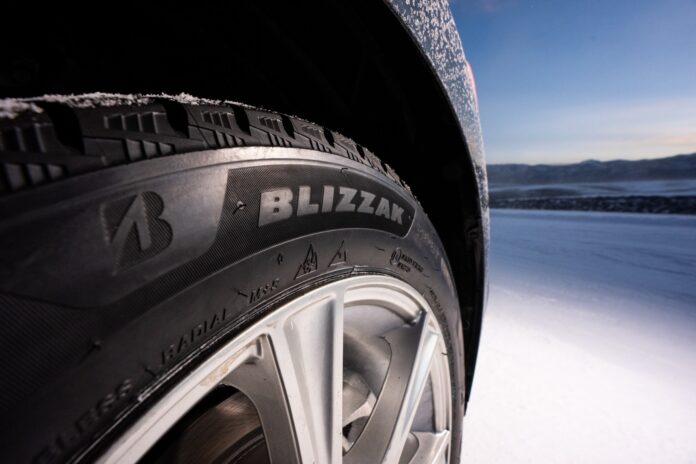

Quick Facts:
- Topic: Winter tires versus 4WD for stopping on snow.
- Core finding: A winter tire stopped from 25 mph on snow in 56.1 feet. An all-season tire needed 81.1 feet.
- Test vehicle: 2025 Toyota Camry on 215/55R17 tires, tested near freezing.
- Temperature rule: Michelin says winter compounds stay flexible below about 45°F.
- New option: Bridgestone Blizzak IcePeak, in 107 sizes from 14 to 22 inches.
- Best for: 4WD and AWD owners who drive in snow country.
5 min read
In This Article
Why Winter Tires Matter More Than 4WD
Four-wheel drive helps you start on snow. Winter tires help you stop. Tire Rack’s March 2026 test shows the gap: the best winter tire stopped from 25 mph on snow in 56.1 feet, while an all-season tire needed 81.1 feet.
Those 25 feet matter to every 4WD owner, because the drivetrain does not change how far you slide. Power reaches the wheels when you accelerate. However, braking and cornering depend on how well each tire grips.
Start with a quick check. Cold air lowers tire pressure, and low pressure shrinks the rubber touching the road. Our guide on how tire pressure affects traction explains the effect. The Accutire MS-4021B reads pressure on a backlit display and lets you check all four tires before each cold snap.

Accutire Digital Tire Pressure Gauge (5-150 psi) psi/bar/kPa/kg-cm2 (Black) | Backlit LCD Display, +/-0.5 psi Accuracy, Auto Shut-Off, Rubber Ergonomic Grip, 4 Valve Caps, Batteries Included, MS-4021B
A pocket digital gauge for checking all four tires as the air cools.
- Backlit display reads in a dark driveway
- Plus or minus 0.5 psi accuracy
- Four valve caps and batteries included
- Reads pressure only, so you still need a pump or compressor to add air
What the Tire Rack Snow Test Shows
Tire Rack tested 10 tires near freezing on a 2025 Toyota Camry in 215/55R17 sizes. The Michelin X-Ice Snow, a winter tire, had the shortest snow stopping distance at 56.1 feet. The Bridgestone Blizzak WS90 followed at 57.3 feet.
In contrast, the all-season tires finished far behind. The Michelin Primacy Tour A/S needed 81.1 feet, and the Michelin Defender2 needed 84.5 feet, the longest in the test. Tire Rack also extrapolated the results to 50 mph, where the gap between the Primacy and the best tire grows to nearly 100 feet.
| Tire | Type | Snow braking from 25 mph |
|---|---|---|
| Michelin X-Ice Snow | Winter | 56.1 ft |
| Bridgestone Blizzak WS90 | Winter | 57.3 ft |
| Bridgestone WeatherPeak | All-weather (3PMSF) | 58.6 ft |
| Michelin CrossClimate2 | All-weather (3PMSF) | 72.4 ft |
| Michelin Primacy Tour A/S | All-season | 81.1 ft |
| Michelin Defender2 | All-season | 84.5 ft |
The test used a mid-size sedan, not a 4WD truck, so your distances will differ. Therefore, trust the ranking, not the exact distances. Tire Rack’s full report also concludes no substitute exists for a dedicated winter tire on snow and ice.
Why 4WD Does Not Shorten Your Stop
Four-wheel drive sends engine power to all four wheels, which helps you climb a snowy grade or pull away from an unplowed curb. However, braking and cornering ask the tire to grip, and the drivetrain adds none.
Tire Rack’s testers state this plainly: no preparation, training or AWD and 4×4 system readies a vehicle to stop at a moment’s notice. Similarly, we made the case about traction hardware in why your lockers are useless if your tires are wrong.
Temperature adds a second reason to look past the drivetrain. Michelin recommends a dedicated winter tire for severe cold and says it stays flexible below about 45°F, according to Global Rescue’s winter driving guide. Conventional compounds often harden as temperatures fall, which reduces grip.
Which Snow Symbols to Trust
Start with the Three-Peak Mountain Snowflake symbol, called 3PMSF. It marks a tire certified in a snow traction test. We explain the pass mark in our 3PMSF guide for all-terrain tires.
However, the symbol does not make an all-weather tire equal to a winter tire. For example, the Bridgestone WeatherPeak stopped in 58.6 feet, close to the winter-tire results. In contrast, the Michelin CrossClimate2 needed 72.4 feet, compared with 63 feet and below for dedicated winter models, according to Tire Rack.
The older M+S mark is weaker. Global Rescue notes it appears on many all-season tires without the same severe-snow certification. Therefore, check your all-terrain tires for the snowflake before the first storm.
What the Blizzak IcePeak Adds for Trucks
Bridgestone’s Blizzak IcePeak replaces the Blizzak WS90 and the Blizzak DM-V2. The company offers it in 107 sizes from 14 to 22 inches. Once every size ships, Bridgestone says the line fits 97% of US light-duty vehicles.
The IcePeak is the first Bridgestone tire with both the 3PMSF mark and the Ice Grip symbol. Bridgestone says Ice Grip certifies the tire beat a reference tire by at least 18% in an ISO ice braking test. Bridgestone also claims longer wear than the WS90 and DM-V2, based on its own testing.
Tire Rack’s March test used the WS90 and did not include the IcePeak. Therefore, the report holds no independent snow braking numbers for the new tire. For a truck or SUV, the IcePeak deserves a look, but published results should drive your final choice.
The Trade-Offs of Winter Tires
Most of these tires trade some wet grip for cold-weather grip. In the same test, the Michelin X-Ice Snow needed 129 feet to stop from 50 mph on wet pavement. The Michelin Primacy Tour A/S needed 99.3 feet, which is 29.7 feet shorter.
Your climate decides whether the trade is worth it. If you rarely see snow or ice, Tire Rack says an all-weather tire is a compelling option. However, if you drive snow roads every winter, the gap in snow stopping distance is the larger risk.
Tires shorten your stop, but they do not free a stuck truck. For this job, the MAXTRAX MKII set includes two nylon boards and two leashes. Carry them for unplowed trailheads and buried ruts, not as a substitute for tires.

MAXTRAX MKII Black Vehicle Recovery Board
Two recovery boards for getting a stuck 4WD moving on snow or sand.
- Two boards and two leashes in the box
- The set weighs 16.9 pounds
- Lifetime manufacturer warranty
- Each board is about 45 inches long, so you need rack or bed space
- Boards free a stuck truck but do not shorten your stopping distance
What This Means for You
Your best purchase depends on how often you drive on snow. Use these rules to decide.
- If you drive snow roads every winter, buy four winter-rated tires. The US Tire Manufacturers Association recommends them at all four positions, according to Global Rescue.
- If you run all-terrain tires, look for the 3PMSF mark and expect longer stops than a dedicated winter tire gives you.
- Where snow is rare, an all-weather tire with the 3PMSF mark is a reasonable compromise.
- If you cross mountain passes, carry traction aids as well. See our guide to tire chains for trucks.
Final Thoughts
If you own a 4WD rig and see snow, I would buy winter tires before any other cold-weather upgrade. Tire Rack’s numbers show a 25-foot gap at only 25 mph, and the gap grows with speed. No drivetrain closes it.
The trade-offs are real. Most of these tires stop longer on wet pavement in Tire Rack’s test. Tire Rack’s report did not include the IcePeak. Therefore, I would wait for published braking numbers before choosing it over a tire with results.
For snow roads, fit four dedicated tires before the first storm and check your pressure before each cold snap. Then use your 4WD for what it does well, which is getting you moving.
FAQ
Do winter tires work better than 4WD on snow?
For stopping, yes. Four-wheel drive helps you accelerate, but the best winter tire stopped from 25 mph in 56.1 feet in Tire Rack’s test. An all-season tire needed 81.1 feet.
Do I need winter tires on all four wheels?
Yes. The US Tire Manufacturers Association recommends them at all four positions instead of mixing types, according to Global Rescue.
Is the 3PMSF symbol enough?
Not for the shortest stop. A 3PMSF tire passed a snow traction test, but the Michelin CrossClimate2 needed 72.4 feet to stop in Tire Rack’s test, compared with 63 feet and below for dedicated winter models.
Do winter tires hurt wet braking?
Yes, on wet pavement. The Michelin X-Ice Snow needed 129 feet from 50 mph, compared with 99.3 feet for the Michelin Primacy Tour A/S.