


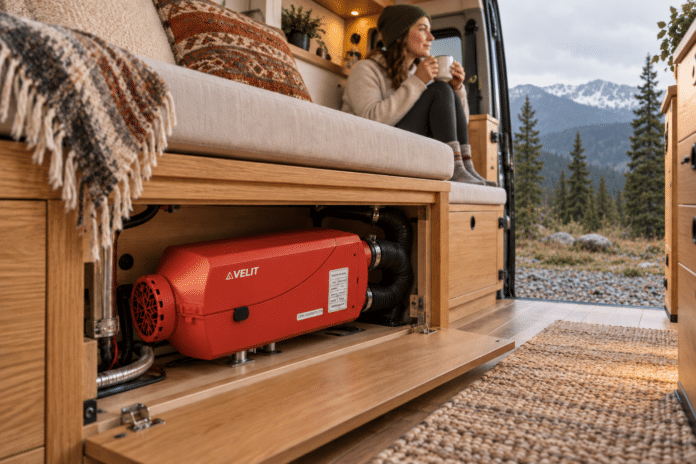

Carbon monoxide safety is the one part of a van heater install you never skip. Every fuel-fired heater makes CO, and a sealed system keeps it outside while a leaky one sends it into the room where you sleep. The gas has no color and no smell, so your nose gives you no warning. Three layers protect you: a correct exhaust route, a sensor built into the heater, and a separate detector near your bed.
We’ve spent years comparing gasoline and diesel air heaters for vans, trucks, and tents, and CO risk shapes every install we recommend. This guide uses the Velit gasoline air heater as the working example, since it carries a built-in CO sensor and sets firm rules for exhaust placement. Read it before you cut a hole in a floor, and read it again before the first cold night.
Quick Facts:
- Topic: Carbon monoxide safety for installed heaters
- Built-in CO shutoff: Alarm and shutdown above 800 ppm
- Exhaust distance: At least 4 ft from vehicle openings
- Exhaust bends: No upward bends, 270 degrees total or less
- Extra sensor: Flammable gas detection built in
- Standalone detector: Still required near your bed
- Heater output: 14,000 BTU (4 kW)
- Price: $729
- Best for: Anyone sleeping in a heated vehicle
8 min read
In This Guide
- Carbon Monoxide Safety Overview
- Carbon Monoxide Safety Features at a Glance
- How CO Enters a Vehicle
- Exhaust Routing for Carbon Monoxide Safety
- Built-In Sensors and Standalone Detectors
- Maintenance Habits for Carbon Monoxide Safety
- Carbon Monoxide Safety Warning Signs and What to Do
- Built-In Sensor vs. Standalone Detector
- Final Verdict
- FAQ
Carbon Monoxide Safety Features at a Glance
| Safety Feature | Velit Specification |
|---|---|
| CO sensor | Built in, alarm and shutdown above 800 ppm |
| Flammable gas sensor | Built in |
| Exhaust distance | At least 4 ft from vehicle openings |
| Exhaust bends | No upward bends, 270 degrees total or less |
| Exhaust outlet angle | 90 degrees, plus or minus 10 degrees |
| Bend radius | At least 50 mm |
| Mounting gasket | Replace at every reinstall |
Buy Direct From Velit
A Heater With CO Sensing Built In
The Velit gasoline air heater shuts down above 800 ppm and ships with a full install kit for $729.
How CO Enters a Vehicle
An air heater keeps combustion gas and room air in separate paths. Fuel burns inside a sealed chamber, a heat exchanger warms the metal, and a fan blows clean cabin air across it. Exhaust leaves through its own pipe under the vehicle. Therefore, CO reaches you only when one of those barriers fails.
Four failures cause most problems. First, a loose or cracked exhaust joint leaks gas under the floor, and the gas drifts up through gaps. Second, a blocked exhaust outlet, often packed with snow or mud, pushes gas back toward the heater. Third, an exhaust outlet placed close to a door, window, or vent lets gas drift inside. Finally, a damaged heat exchanger passes combustion gas into the warm air stream.
Carbon Monoxide Safety in Snow or Wind
Weather changes where exhaust goes. A vehicle parked against a snowbank traps gas near the outlet, and a strong wind pushes it toward the cabin. Consequently, check the outlet before you sleep, and clear any snow around it. This takes about thirty seconds and removes one of the most common risks.
Intake air deserves the same attention. Keep the combustion air intake clear of the exhaust outlet, so the heater never breathes its own gas. Also, keep both pipes free of dents and kinks, since a crushed pipe restricts flow and raises pressure inside the system. As a result, a quick walk-around with a flashlight before bed catches problems early.
Exhaust Routing for Carbon Monoxide Safety
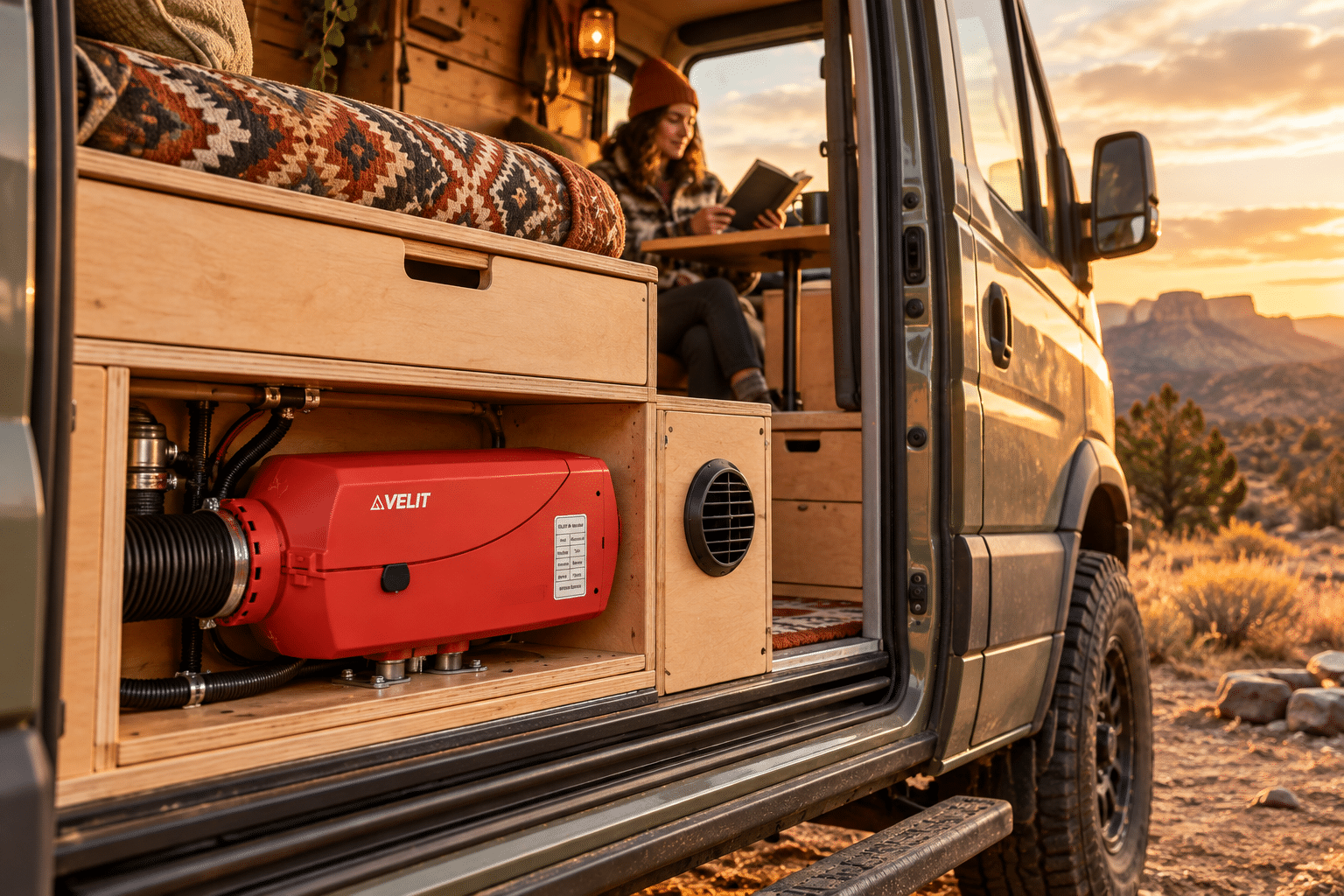
Exhaust routing sets your baseline protection. The Velit manual requires the outlet to sit at least 4 ft from vehicle openings, with no upward bends. Total bends stay at 270 degrees or less, and each bend keeps a radius of at least 50 mm. Outlet angle sits at 90 degrees, plus or minus 10 degrees.
Gas should leave the vehicle and stay out. For example, route the pipe to the underbody, point it away from the sliding door, and keep it clear of the fuel tank. Moreover, sharp bends restrict flow and trap carbon, so smooth curves protect both the heater and your air quality.
Placement of the heater itself also matters. Our guide to air heater mounting layouts compares under-seat, floor, and bench installs, and each layout changes how long and how straight the exhaust run becomes.
Safety note: Never vent a heater exhaust into a cabinet, a wheel well opening, or the cargo area. Gas needs a straight path to open air outside the vehicle.
Gaskets and Seals for Carbon Monoxide Safety
Every joint is a possible leak. Velit’s manual calls for a new sealing gasket each time you reinstall the heater, and it sets a torque of 6 to 7 Nm on the four M6 mounting nuts. In addition, floor panels thinner than 1.5 mm need a reinforcing plate, so the seal stays tight under vibration. Use fresh clamps on every exhaust joint, since old clamps loosen after months of road shake.
Built-In Sensors and Standalone Detectors

The Velit heater carries a built-in CO sensor and a flammable gas sensor. When CO passes 800 ppm, the heater sounds an alarm and shuts off. This protects you from a fault near the heater, and it works even when you forget to check anything before bed.
A built-in CO sensor still has limits. It watches the air near the heater, while you sleep several feet away. Gas takes time to travel, and cabin air mixes unevenly. Therefore, add a separate detector as a second layer. Redundancy costs little compared with the risk.
Where to Place a Standalone Detector
Mount the detector near your head height in the sleeping area, away from the heater outlet and away from a window gap. Pick a unit rated for vehicles or small spaces, since home models expect stable temperatures. Also, choose one with a battery backup and a digital readout, so you see low readings before an alarm sounds.
Test the unit when you pack for each trip. Press the test button, confirm the alarm, and replace the battery on a schedule you set. Check the maker’s replacement date as well, since sensors wear out over time.
Maintenance Habits for Carbon Monoxide Safety
Maintenance keeps the system tight. The Velit manual recommends running the heater for at least 15 minutes each month, even in summer, which burns off carbon and keeps fuel moving. Inspect the fuel line often for leaks, and replace the fuel filter every two years.
Add an exhaust check to the routine. Look for soot, loose clamps, rust, and cracks along the pipe. Next, confirm the outlet sits clear of dirt and snow. Finally, listen for new noises at startup, because a rattle often points to a loose joint.
If you want the full spec list and owner feedback, our Velit gasoline air heater review covers the unit in depth. In contrast, this guide stays on safety.
Safety Built In
CO and Gas Sensors, Plus a Two-Year Warranty
Bluetooth control and a smart thermostat come standard with every unit.
Pre-Trip Carbon Monoxide Safety Checklist
A short checklist turns good intentions into habit. First, test the detector and confirm the alarm sounds. Next, inspect the exhaust pipe, clamps, and outlet for soot, rust, or damage. Then run the heater for a few minutes and listen for odd noises. Finally, clear snow or debris from the outlet and the intake. Five minutes of checking beats a night of worry, and it keeps the layered system working as designed.
Carbon Monoxide Safety Warning Signs and What to Do
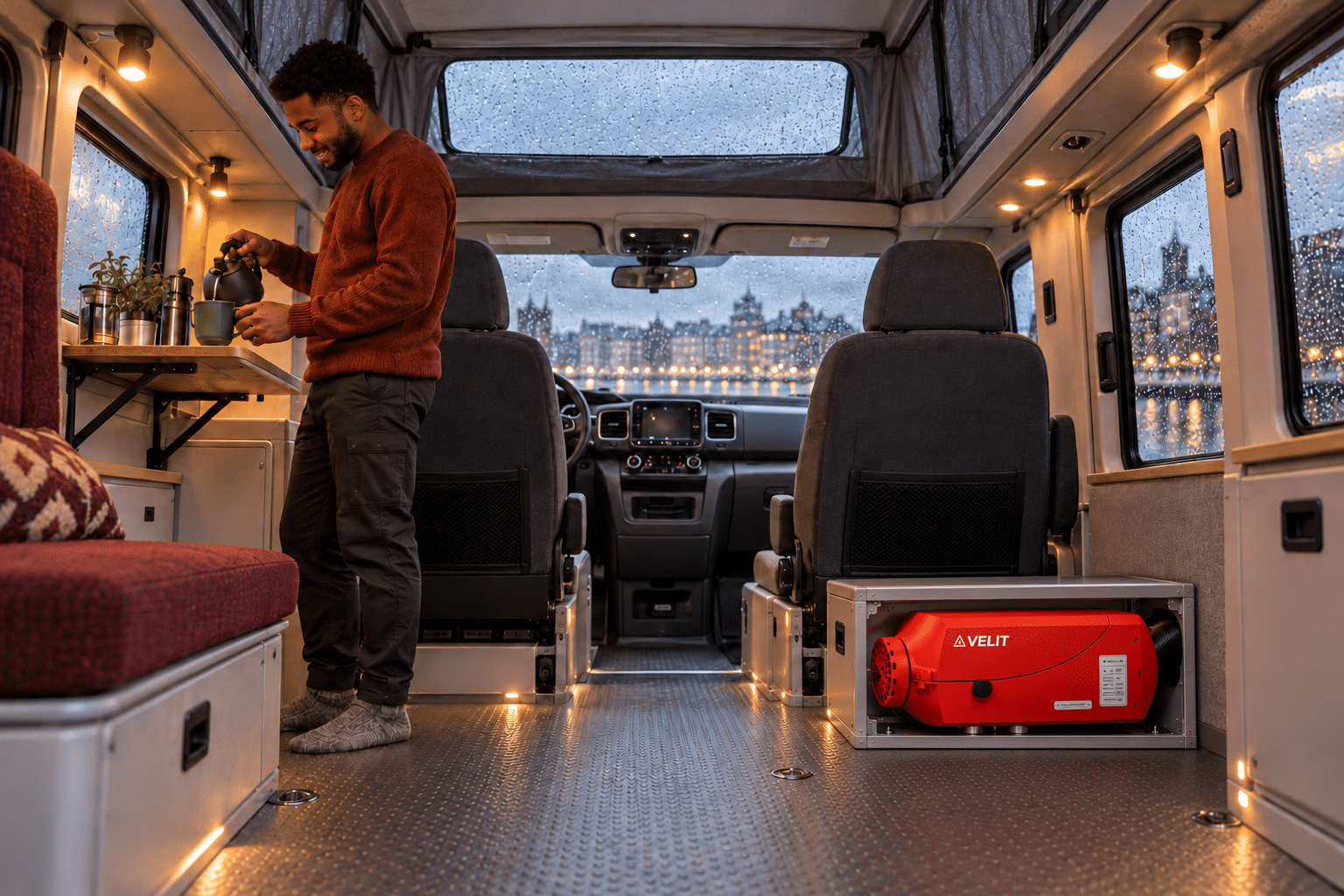
CO poisoning feels like a mild illness at first. Headache, dizziness, nausea, and confusion are the common signs, and sleepers often feel nothing before they pass out. Several people in one space with the same symptoms is a strong clue.
Safety note: If an alarm sounds or anyone feels dizzy or sick, shut off the heater, open the doors, and get everyone into fresh air at once. Call emergency services, and do not go back in until the vehicle is checked.
After an alarm, find the cause before you use the heater again. Inspect the exhaust pipe, the outlet, and every joint. When you find no cause, hire a qualified installer, because a hidden crack or a damaged exchanger needs professional repair.
Built-In Sensor vs. Standalone Detector
| Factor | Built-In Sensor | Standalone Detector |
|---|---|---|
| Location | At the heater | Where you sleep |
| Action on alarm | Alarm and automatic shutdown | Alarm only |
| Covers other CO sources | No | Yes, any source in the room |
| Needs battery care | No, runs on the heater circuit | Yes |
| Best role | First line, stops the source | Backup, protects the sleeper |
Both layers work as a team. Your built-in sensor stops the heater, while the standalone unit also catches CO from a generator, a stove, or the engine. For example, a camp stove used indoors makes CO on its own, and only a room detector sees it. Both layers cost far less than one night of bad luck.
Final Verdict

Velit’s gasoline air heater suits anyone who wants CO protection built into the heater. Its 800 ppm shutoff, flammable gas sensor, and clear exhaust rules give you a solid base. Combine them with a standalone detector and a clean install, and you cover the main risks.
Trade-offs are plain. The built-in CO sensor does not replace a bedside detector, and no sensor fixes a bad exhaust route. Anyone unsure about fuel or exhaust work should hire a certified installer. Heaters in tents, where a sealed exhaust is harder to guarantee, need a different approach.
On value, the $729 price includes a sensor package many budget heaters leave out. A detector adds a small extra cost, and the two together form a layered system.
We recommend the Velit gasoline air heater for vans and trucks, paired with a vehicle-rated detector at sleeping height. Test both before every trip, and clear the exhaust outlet each night.
Ready to Buy?
Sleep Warm With Safety Built In
Order the gasoline or diesel version direct from Velit for $729.
FAQ
Is an installed vehicle heater safe to sleep with?
Yes, when the exhaust vents outside the vehicle and you run a working CO detector. Velit’s heater also shuts off if CO passes 800 ppm.
Do I need a second detector if my heater has a sensor?
Yes. Your built-in sensor watches the air near the heater, while a CO detector at sleeping height protects you from any CO source in the room.
How far should the heater exhaust sit from windows and doors?
Velit’s manual calls for at least 4 ft from vehicle openings, with no upward bends in the pipe.
What should I do if the CO alarm sounds?
Shut off the heater, open the doors, and move everyone into fresh air. Call emergency services, and do not return until the cause is found.
How often should I test the heater and detector?
Test the detector before each trip. Run the heater for at least 15 minutes each month, and inspect the exhaust pipe and joints for soot, rust, and loose clamps.
Just so you know, some of the cool stuff we mention comes with affiliate links, meaning we earn a commission if you buy (no extra charge to you!). Plus, we occasionally feature sponsored content, but rest assured, we only shout out products we genuinely stand behind.