


The car camping vs. overlanding vs. RV travel question comes up around nearly every campfire I sit beside. I’ve spent 30+ years camping, founded 4WDTalk, and tested more gear than my storage unit wants to hold. In all those seasons, I’ve watched good people spend big money on the wrong setup for how they like to travel. For example, a family of five buys a rooftop tent built for two. Meanwhile, a solo weekender signs a 15-year loan on a 32-foot motorhome. The gear wasn’t the problem; the match was.
This guide breaks down all three camping styles the way I’d explain them to a friend over coffee. Specifically, you’ll see what each one costs, who each one suits, and where each one falls apart. I’ll also show you the middle path I recommend most often. For a lot of campers, the right answer sits between a loaded trunk and a rolling apartment.
Quick Facts:
- Topic: Car camping vs. overlanding vs. RV travel
- Startup cost range: $300 (car camping) to $300,000+ (Class A motorhome)
- Lowest barrier to entry: Car camping with gear you already own
- Most adventure access: Overlanding on public land and backcountry routes
- Most comfort: RV travel with full kitchens, bathrooms, and climate control
- Middle-ground option: The Rustic Mountain Overland Patrol XCT trailer ($13,495)
- Best for: Campers choosing a setup before spending big
9 min read
In This Guide
- Car Camping vs. Overlanding vs. RV Travel: The Basics
- What Each Camping Style Costs
- Car Camping: The Simple Starting Point
- Overlanding: When the Journey Is the Point
- RV Travel: Comfort First, Adventure Second
- Off-Road Trailer vs. RV: The Middle Ground
- Pros and Cons of the Trailer-Based Setup
- Final Verdict: Car Camping vs. Overlanding vs. RV Travel
- Frequently Asked Questions
Car Camping vs. Overlanding vs. RV Travel: The Basics

First, some quick definitions, because these terms get blurry. Car camping means driving to a campsite, usually an established one, and sleeping in a ground tent or in the vehicle itself. Overlanding means self-reliant, vehicle-based travel where the journey matters as much as the destination, often on unpaved roads far from hookups. RV travel means towing or driving a recreational vehicle with built-in living space. You then park it at campgrounds with water, power, and sewer connections.
Here’s the truth from someone who has done all three: no single winner exists. Each camping style trades money, comfort, and access in a different ratio. Car camping wins on cost. Overlanding wins on access and adventure. RV travel wins on comfort and convenience, especially for families and longer stays.
The mistake I see most often is buying for an imagined life instead of a real one. For example, a $90,000 motorhome makes little sense if you camp six weekends a year within two hours of home. Likewise, a stripped-down overlanding rig frustrates a partner who wants a comfortable base camp. Match the setup to your real trips, not the ones you scroll past on Instagram.
What Each Camping Style Costs
Money shapes this decision more than anything else, so let’s put real numbers on the table. The figures reflect current market pricing as of mid-2026.
| Style | Typical Startup Cost | Best For |
|---|---|---|
| Car camping | $300 to $1,000 in gear | Beginners and casual weekenders |
| Overlanding vehicle build | $2,000 to $30,000+ in gear and mods | Journey-focused explorers |
| Patrol XCT trailer | $13,495 base price | Base campers who want backcountry access |
| Travel trailer (new, mid-level) | $25,000 to $60,000 | Comfort-first families at campgrounds |
| Motorhome (Class C to Class A) | $80,000 to $300,000+ | Full-timers and long-haul travelers |
Ongoing costs deserve attention too. Motorhome owners commonly spend $5,000 to $15,000 per year on fuel, insurance, storage, and campsites. By contrast, a small trailer or tote of camp gear costs almost nothing between trips.
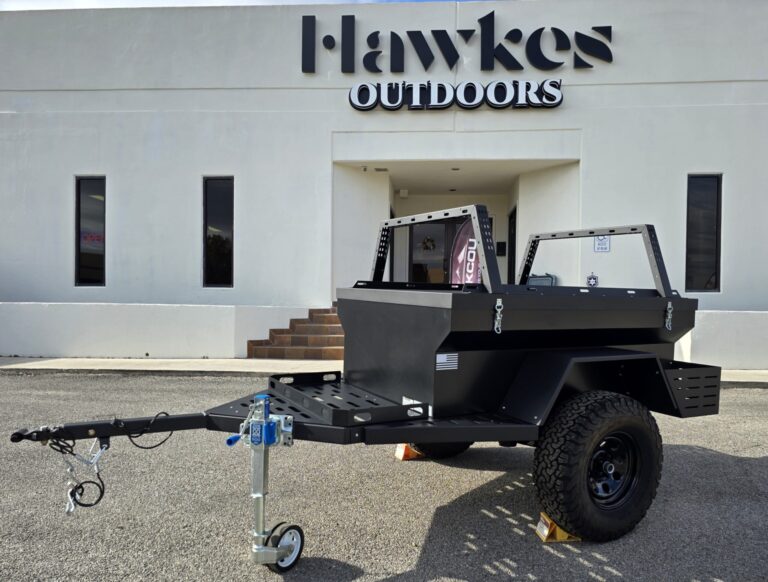
2025 Rustic Mountain Overland Patrol XC
The baseline Patrol, and the cheaper of the two Rustic Mountain trailers Hawkes Outdoors has on the lot. Enclosed cargo bay with a tilting lid and rear tailgate, Timbren HD 2200 lb axleless suspension, and 31-inch AT tires on 15-inch wheels. Listed at $10,737 in black, stock SA1124.
- Enclosed, lockable cargo bay
- Timbren HD 2200 lb axleless suspension
- 31-inch AT tires on 15-inch wheels
- Lock-N-Roll articulating hitch
- ARK tongue jack
- No tongue box, so galley gear rides in the main bay
- One unit on the lot at this price
Car Camping: The Simple Starting Point

Car camping deserves more respect than it gets in overlanding circles. For roughly the cost of a nice cooler, you get a tent, sleeping bags, pads, a stove, and a lantern. Every camper I know started here, including me, and many never need anything more.
Equally important, the strengths are real. For instance, setup knowledge transfers from any backyard campout, and established campgrounds offer bathrooms and water. The whole kit also stores on two garage shelves. Additionally, your daily driver does the hauling, so there’s no second vehicle and no storage fee.
However, the limits show up at the edges. Ground tents soak up storms, and packing the trunk becomes a weekly puzzle. Rough forest roads also stop a low-clearance sedan miles short of the good spots. Once you start craving quieter, wilder places, you’ve outgrown the style. At our Wyoming home base, the best campsites sit well past the pavement, and a loaded hatchback doesn’t get there.
Overlanding: When the Journey Is the Point

By contrast, overlanding flips the formula. Instead of driving to a destination and staying put, you travel through remote country, and camp happens wherever the day ends. Notably, self-reliance defines the approach. You carry your water, recovery gear, food, and shelter, including a rooftop tent mounted to the rig.
Above all, the payoff is access. Millions of acres of public land allow dispersed camping at no charge, including vast tracts managed by the Bureau of Land Management. On a good route, you’ll wake up alone at a lake the campground crowd will never see. My write-up on dispersed camping done right explains how to use these spots responsibly.
However, the costs climb quickly. Suspension, tires, storage systems, fridges, and power add up fast. As a result, a serious build runs anywhere from $2,000 to north of $30,000 on top of the vehicle. There’s also a skills tax. Airing down, reading terrain, and self-recovery take practice, and breakdowns happen far from cell service. Comfort takes the biggest hit, since everything you bring must fit inside or on top of the rig. Sleep setups spark endless debate, which is why I compared truck bed tents, rooftop tents, and trailers in a separate guide.
RV Travel: Comfort First, Adventure Second

On the far end of the spectrum sits the RV. A modern travel trailer or motorhome carries a real bed, a kitchen, a bathroom, and air conditioning. Storage for weeks on the road comes standard too. For families with young kids, retirees chasing warm weather, or anyone camping for months at a stretch, the comfort case is strong.
The trade-offs are equally strong. A new mid-level travel trailer runs $25,000 to $60,000. Well-equipped Class C motorhomes commonly land between $80,000 and $150,000. Fuel stings as well, with big Class A rigs averaging 8 to 10 mpg. Then come the quieter costs: insurance, winterizing, storage fees, and campground reservations booked months ahead during peak season.
Access shrinks too. RVs live on pavement and gravel, which rules out most of the backcountry. The wildest view from an RV park is usually the rig parked next to you. For some campers, full hookups and a hot shower beat solitude, and there’s no shame in it. Still, if remote country pulls at you, an RV will feel like an anchor.
Off-Road Trailer vs. RV: The Middle Ground Most Campers Miss

Here’s where I’ll share the opinion I give friends who feel stuck between these options: look hard at a purpose-built off-road trailer. After years of towing one behind my Jeep, I’m convinced it settles the debate for most people. You keep the access of overlanding because the trailer follows your 4×4 anywhere reasonable. At the same time, you gain the organized storage and quick camp setup people buy RVs to get. I’ve written before about why an off-road trailer improves your base camp; the case holds up trip after trip.
The Rustic Mountain Overland Patrol XCT is a strong example of the breed. It weighs 1,250 lbs, so a midsize SUV or pickup tows it without strain. In addition, a Timbren HD 2,200 lb axleless suspension and 31-inch all-terrain tires on 15-inch wheels let it track behind your rig on rough two-track. Meanwhile, the tongue box swallows a fridge and electrical system. Up front, a cargo basket and 16-inch roof rack carry bulky gear, while the tilting lid keeps everything reachable. Finally, a Lock-N-Roll hitch gives it full articulation on uneven ground.
Compared with an RV, the differences are simple. The XCT costs $13,495 instead of $30,000 to $150,000. It also follows you onto trails no travel trailer survives, then stores in a standard garage bay. It’s built in Alabama, with financing available. For a deeper look at build quality and field performance, read my full Patrol XCT review. What you give up is interior living space; you’ll still sleep in a rooftop tent or ground tent rather than a climate-controlled box.
Pros and Cons of the Trailer-Based Setup
To keep things honest, here’s how the overland trailer option stacks up after hundreds of nights outside.
Pros
- Backcountry access an RV will never match, thanks to a 1,250 lb curb weight and off-road suspension
- $13,495 base price beats new travel trailers ($25,000 to $60,000) by a wide margin
- Tows behind most midsize SUVs and trucks without drivetrain upgrades
- Camp stays set up while you take the tow rig out for day runs
- Tongue box, cargo basket, and 16-inch roof rack organize gear far better than a packed trunk
- Fits in a normal garage, so no monthly storage fee
Cons
- No enclosed living space, bathroom, or climate control like an RV provides
- Towing on technical trails takes practice, especially backing up
- Costs more upfront than a complete car camping kit ($300 to $1,000)
- Adds registration, tires, and bearing maintenance to your ownership list
Final Verdict: Car Camping vs. Overlanding vs. RV Travel

First, stay a car camper if you camp a handful of weekends a year at established campgrounds and your budget tops out under $1,000. The style is cheap, simple, and genuinely fun until your trips demand more. Honestly, some of my favorite memories come from a $150 tent.
Next, choose RV travel if comfort outranks adventure on every trip and you camp for weeks at a time. The $25,000 to $150,000+ commitment must also fit your finances. Families with toddlers and full-time travelers get real value here. Be clear-eyed about the ongoing costs, though, since $5,000 to $15,000 per year surprises many first-time owners.
Finally, go overlanding if the drive itself is the draw and you’re willing to build skills along with your rig. For most readers in between, my recommendation after three decades outdoors is the middle path. Keep a capable tow vehicle, hitch up a trailer like the Patrol XCT, and get the best of both worlds. Specifically, you’ll camp where the RVs turn around, with organized storage and a fast, comfortable camp.
If an American-made overland trailer sounds like your kind of compromise, start with the Patrol XCT. Although cheaper utility trailers exist, few arrive trail-ready with suspension, storage, and a roof rack already sorted.
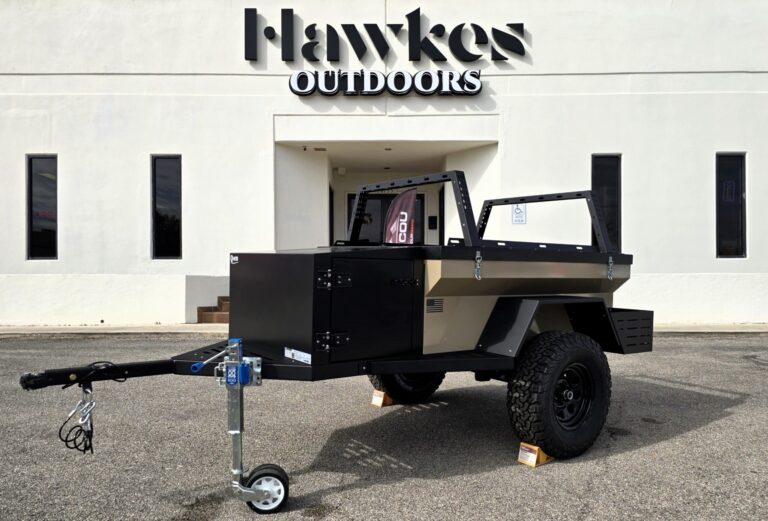
2025 Rustic Mountain Overland Patrol XCT
The XC with a lockable tongue box added forward on the frame, sized for a fridge, electrical, and galley gear, with an access door on the driver and passenger side. That is the piece that keeps cooking gear out of the main bay entirely. 1,250 lbs, tan, listed at $11,489, stock SA1122.
- Tongue box with driver and passenger access doors
- Enclosed main bay with tilting lid and rear tailgate
- Timbren HD 2200 lb axleless suspension
- Custom 16-inch roof rack and front cargo basket
- 1,250 lbs dry
- About $750 more than the Patrol XC
- One unit on the lot at this price
Frequently Asked Questions
Is overlanding the same as car camping?
No, although they overlap. Car camping centers on a destination, usually an established campground reached by pavement. Overlanding centers on the journey, with self-reliant travel across remote terrain and camps wherever the route leads. In the car camping vs. overlanding debate, the deciding factor is whether you stay put or keep moving.
Is an overland trailer cheaper than an RV?
Almost always. The Patrol XCT runs $13,495 new. By contrast, new mid-level travel trailers cost $25,000 to $60,000, and motorhomes start around $80,000. It also avoids most RV ownership costs, including storage fees and winterizing.
Do you need a 4×4 to start overlanding?
Not for milder routes. A stock all-wheel-drive SUV handles most maintained forest roads. Four-wheel drive, higher clearance, and all-terrain tires become important on rockier or more remote terrain. Therefore, build toward the routes you want to run.
What makes the Patrol XCT a good first overland trailer?
Its 1,250 lb weight keeps towing easy for beginners. Meanwhile, the Timbren axleless suspension and Lock-N-Roll hitch handle rough ground without drama. The tongue box, tailgate, and roof rack also organize gear from day one.
Heads up: Clicking on our affiliate links and exploring our sponsored content helps us at no extra cost to you, and we only recommend gear we’re absolutely crazy about!