


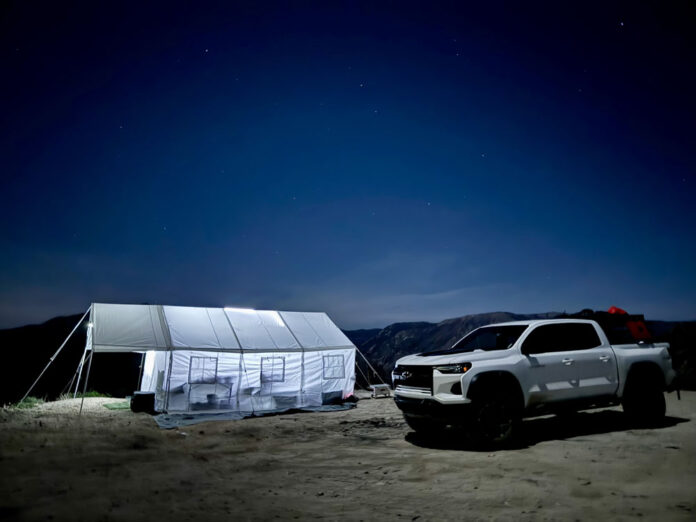

I’ve tested dozens of tents over the years. Some were good, some were bad, and a few earned a permanent spot in my gear rotation. Camping and overlanding have filled most of my life. Beyond decades outdoors, my work as the founder of 4WDTalk connects me with industry insiders at trade shows worldwide. Those conversations sharpened my eye for what separates a serious shelter from a forgettable one. During a recent overnight field test near Big Bear, California, the Elk Mountain wall tent landed firmly in the serious category.
Specifically, this review covers the 13×16 wall tent with awning. My first pitch happened at roughly 5,500 feet of elevation, followed by a night in 42 degree weather. Below, you’ll find my honest take on setup time, materials, interior space, overnight warmth, and the one thing I didn’t like. By the end, you’ll know whether this canvas wall tent deserves a spot at your basecamp.
Quick Facts:
- Product: Elk Mountain wall tent, 13×16 with awning and front screen door
- Material: 11 oz PolyShield polyester canvas, no rainfly needed
- Tear strength: 67 lbs warp / 40 lbs fill, roughly double traditional cotton canvas
- Doors and windows: Two zippered doors, six screened windows, two gable vents
- Frame: Angle kit included; poles sold separately or DIY with 1-inch EMT conduit
- Setup time: About 60 minutes for a first pitch with two people
- Price: $1,450 to $1,749 depending on size, with free shipping
- Best for: Hunting groups, families, and overlanders running a long-stay basecamp
9 min read
In This Review
- Elk Mountain Wall Tent Overview: A Basecamp Worth Slowing Down For
- Key Specs at a Glance
- Setting Up the 13×16 Wall Tent
- PolyShield Canvas and Build Quality
- Interior Space, Light, and Layout
- Living Under the Awning
- Overnight Warmth at 42 Degrees
- Wall Tent vs. Bell Tent: Which Should You Pick?
- Pros and Cons
- Final Verdict
- Frequently Asked Questions
Elk Mountain Wall Tent Overview: A Basecamp Worth Slowing Down For

I’ve tested dozens of tents over the years. Some were good, some were bad, and a few earned a permanent spot in my gear rotation. Camping and overlanding have filled most of my life. Beyond decades outdoors, my work as the founder of 4wdTalk connects me with industry insiders at trade shows worldwide. Those conversations sharpened my eye for what separates a serious shelter from a forgettable one. During a recent overnight field test near Big Bear, California, the Elk Mountain wall tent landed firmly in the serious category.
Specifically, this review covers the 13×16 wall tent with awning. My first pitch happened at roughly 5,500 feet of elevation, followed by a night in 42 degree air. Below, you’ll find my honest take on setup time, materials, interior space, overnight warmth, and the one thing I didn’t like. By the end, you’ll know whether this canvas wall tent deserves a spot at your basecamp.
So who is this shelter for? In short, anyone who stays put for days at a time. Hunting groups, large families, and overlanders who treat camp as a destination all fit the profile. Compared to a typical nylon family tent, you’re trading quick setup for standing headroom, stove compatibility, and fabric built to survive decades of abuse. For a deeper spec rundown of the entire lineup, see our full Elk Mountain canvas wall tent breakdown.
Pricing for the awning and screen door model runs $1,450 to $1,749 depending on size, and shipping is free. The number sounds steep next to a big-box dome tent. However, it sits at the value end of the canvas tent market. For perspective, compare fabric weight, hardware, and included accessories against competing brands.
Key Specs at a Glance
| Specification | Details |
|---|---|
| Model tested | 13×16 wall tent with awning and front screen door |
| Available sizes | 13×13, 13×16, 13×20 |
| Fabric | 11 oz PolyShield polyester canvas |
| Breaking strength | 449 lbs warp / 382 lbs fill |
| Tear strength | 67 lbs warp / 40 lbs fill |
| Doors | Two zippered doors, one on each end, plus front screen door |
| Windows | Three screened windows per side, plus screened gable vents |
| Stove compatibility | Uncut fiberglass stove jack with cover |
| Frame | Angle kit included; poles sold separately or DIY conduit |
| Floor | Sold separately; textured heavy-duty material with sod cloth seal |
| Price | $1,450 to $1,749, free shipping |
| Customer rating | 4.89 out of 5 from 44 reviews on the product page |
Buy Direct From Elk Mountain
Canvas Wall Tent With Awning and Screen Door
Available in 13×13, 13×16, and 13×20 sizes with free shipping on every order.
Setting Up the 13×16 Wall Tent
Full disclosure: my first pitch took about an hour. My buddy Caleb and I arrived after dark, unpacked an unfamiliar shelter, and worked through the frame assembly by headlamp. For a first attempt on a structure this large, an hour felt fair. After learning the sequence, I expect the second pitch to land between 30 and 40 minutes, and I’ll time it on camera to hold myself accountable.
One detail worth learning before your first trip is the sod cloth. Because the floor drops in after the walls go up, a fabric skirt runs around the tent’s perimeter. Tuck it inward under the legs before laying the floor down. As a result, the floor presses the sod cloth flat and forms a seal against bugs, dust, and drafts. Skip this step and you’ll leave a gap critters will happily find.
The stakes also deserve a mention. After years of griping about flimsy hardware, I was genuinely surprised here. These are the heaviest duty stakes I’ve used with any tent in my testing history. In fact, I plan to keep them in my kit for other shelters too. Likewise, the included angle kit makes the frame straightforward; you supply the poles or order them separately from the company.
PolyShield Canvas and Build Quality
Traditional cotton canvas rots, molds, stains, and soaks up water like a sponge. Elk Mountain went a different direction. Their PolyShield canvas is an 11 oz polyester blend with a breaking strength of 449 lbs in the warp direction and 382 lbs in the fill direction. Tear strength measures 67 lbs warp and 40 lbs fill, roughly double the Sunforger cotton fabric used by competing tent makers. In hand, the material feels like classic canvas while weighing noticeably less.
Hardware quality matches the fabric. For example, the D-rings holding the doors open are heavy duty. Storm flaps with backup buckles protect the zippers, and every corner is reinforced where the fabric meets the poles. Even small touches impressed me, such as the pull cords on the gable vents. Pull one cord and the vent opens; pull the other and it closes, all from ground level.
Aluminum rafters keep the frame weight reasonable for a shelter this size. Consequently, two people handle the whole setup without strain, and the company states its largest 13×20 model weighs under 70 lbs in tent fabric alone. To learn more about the material itself, the Elk Mountain Tents website publishes full PolyShield specs and testing details.
Interior Space, Light, and Layout

Step inside and the first impression is volume. The 13×16 footprint gives you 208 square feet of floor space with standing headroom throughout. There’s room for cots, a table, gear bins, and a wood stove without anyone tripping over anything. We even set up a projector for a movie night, which tells you something about how livable this space is.
Natural light is another strength of this canvas wall tent. With three screened windows on each side, two large doors, and the light-colored fabric overhead, the interior stays bright and airy even with the windows closed. Roll the window flaps up, secure the Velcro tabs, and a cross breeze moves through the whole structure. On warm afternoons, the screened gable vents dump rising heat out the top.
For lighting after dark, I ran LED strips along the aluminum rafters. One practical note: the rafters themselves won’t hold magnets, although the galvanized steel connector fittings will. Therefore, I used Velcro wraps on the aluminum spans and let the magnets grab the steel fittings up top. Plan your lighting mounts accordingly.
Living Under the Awning
The awning turned out to be my favorite feature of the entire wall tent with awning package, and I didn’t expect it to hit this hard. Picture a covered porch cantilevered off the front of your shelter, big enough for chairs, a table, and a fridge. On the first morning, I sat under it with my coffee for over 90 minutes, working on my laptop and staring at the mountain view. Even after the coffee ran out, I stayed put.
Beyond comfort, the awning solves real problems. During rain, it gives you a dry transition zone for muddy boots and wet gear. Under summer sun, the light-colored fabric throws deep shade across the entire front of the tent. Optional awning walls take it further; zip them in and you enclose the whole porch, or run the screen panels and create a bug-free outdoor room. I left the walls off this trip to keep the view open, but I’ll test the enclosed configuration in a follow-up.
Save on the 13×16 Wall Tent
Get the Awning and Screen Door Package
The awning model adds a covered porch and bug-free outdoor living space to your basecamp.
Overnight Warmth at 42 Degrees

Conditions on my test night were mild but useful. The outside thermometer read 42 degrees Fahrenheit, with no wind. Inside, a small portable gas heater held the interior at 62 degrees by morning. Considering the structure spans 208 square feet with tall walls, those numbers impressed me. For genuinely cold weather, the uncut fiberglass stove jack accepts a 4, 5, or 6 inch pipe opening. Add a proper wood stove and this becomes a four-season shelter.
Sleep quality was excellent. Between the quiet fabric, the still air, and the insulated quilt on my cot, I woke up with zero desire to break camp. In fact, the hardest part of this Elk Mountain wall tent test was packing up and leaving the view behind.
Wall Tent vs. Bell Tent: Which Should You Pick?
Elk Mountain builds both styles from the same PolyShield canvas, so durability is a wash. The differences come down to shape and workflow. A wall tent’s vertical sidewalls deliver 30 to 40 percent more usable floor space per square foot, and the boxy layout heats more efficiently with a wood stove. However, a bell tent pitches in 15 to 20 minutes with one person and weighs 30 to 50 percent less, which suits camps you move frequently.
My rule of thumb: choose the wall tent for long stays with a group, and choose the bell for solo or couple trips where mobility matters. I pushed the brand’s shelter through 41 mph winds and heavy snow in my Elk Mountain Yukon Bell Tent review. It survived everything the mountain threw at it. For a full side-by-side with specs and pricing, read our wall tent vs bell tent comparison.
Pros and Cons of the Elk Mountain Wall Tent
Pros
- Massive 208 square foot interior with standing headroom throughout
- PolyShield fabric with roughly double the tear strength of traditional cotton canvas
- Six screened windows and two gable vents flood the space with light and airflow
- Awning creates a shaded porch with optional walls and screen panels
- Heaviest duty stakes I’ve used across dozens of tents tested
- Aluminum rafters keep frame weight manageable for two-person setup
- Held 62 degrees inside on a 42 degree night with a small gas heater
- Free shipping and a 4.89 out of 5 rating from 44 buyer reviews
Cons
- Storage bag is undersized; I failed to repack the tent after three attempts
- First setup takes about 60 minutes and benefits from two people
- Poles are not included; you buy them separately or build a conduit frame
- Floor is a separate purchase rather than a bundled item
Final Verdict

The Elk Mountain wall tent earns an easy recommendation for hunting groups, big families, and overlanders building a long-stay basecamp. Its biggest strength is livability. Think 208 square feet of standing-height space, plus a porch-style awning and fabric engineered to outlast cotton canvas.
Still, the trade-offs are real. A 60 minute first pitch and a two-person setup rule it out for solo weekenders who relocate camp daily. Budget for poles and the floor on top of the tent price, because both ship separately. Also, the undersized storage bag frustrated me; the owner confirmed a larger replacement bag is already in development, which earns a thumbs up for responsiveness.
On value, the package holds up well. At $1,450 to $1,749 with free shipping, you’re paying less than many competitors charge for lighter-duty cotton shelters. Meanwhile, customer reviews back up the durability claims with reports of years of hard use.
My recommendation: buy the awning model if you camp in place for three or more nights at a time. If you move camp constantly or camp solo, the Yukon Bell Tent from the same company delivers similar fabric quality in a faster-pitching package.
Ready to Buy?
Check Today’s Price on the Elk Mountain Wall Tent
Every order ships free, and the product page holds a 4.89 out of 5 rating from verified buyers.
Frequently Asked Questions
How long does it take to set up the Elk Mountain wall tent?
Expect about 60 minutes for a first pitch with two people. After learning the frame sequence, experienced owners report times closer to 30 to 40 minutes. Setting up in daylight on level ground speeds things considerably.
Does the wall tent come with poles?
No, poles ship separately. However, the angle kit is included, so you build a complete frame from purchased poles or 1-inch EMT conduit cut to the included instructions. Many owners go the conduit route to save money.
How many people fit in the 13×16 wall tent?
With cots and a wood stove, the 13×16 wall tent comfortably sleeps four to six adults with gear. For tighter family-style sleeping arrangements without a stove, the count climbs higher. Outfitters running the larger 13×20 fit eight to ten hunters on cots.
Is the PolyShield canvas waterproof?
Yes. The polyester fabric is treated for water resistance, doesn’t absorb water like cotton, and arrives seam sealed. Unlike cotton shelters, it requires no rainfly, and it resists mold and rot over long-term storage.
Does a wood stove work in this tent?
Absolutely. Every size includes an uncut fiberglass stove jack with a cover, so you cut a 4, 5, or 6 inch opening to match your stove pipe. Wear gloves when cutting, because the fiberglass material irritates bare skin.
What sizes does the canvas wall tent come in?
Three sizes are available: 13×13, 13×16, and 13×20. All three share the same fabric, hardware, and window layout, so the choice comes down to group size and how much gear you haul to camp.
Our articles might have affiliate links and the occasional sponsored content, but don’t sweat it – if you buy something, we get a little kickback at no extra cost to you, and we only hype products we truly believe in!