



Quick Facts:
- Product: Cybertake S2 Pro Portable Camping Air Conditioner
- Cooling capacity: 5,100 BTU (1,500W)
- Heating capacity: 6,100 BTU (1,800W auxiliary)
- Weight: 25.57 lbs (11.6 kg)
- Power input: 48V DC, 12-24V vehicle with booster, 100-240V AC, no internal battery
- Noise: 40 dB minimum, 55 dB on auto
- Ventilation: Dual hose, IPX4 water resistance
- Warranty: 1 year full unit, 2 years on compressor
- Price: $1,079 on Amazon, $899 direct from Cybertake
- Best for: Tent campers and overlanders who already own a 1,500Wh power station
9 min read
In This Review
- Cybertake S2 Pro Tent Air Conditioner Overview
- Key Specs at a Glance
- 45-Day Tent Air Conditioner Field Test
- Power Draw and the No-Battery Tradeoff
- Cooling, Noise, and the Dual-Hose System
- Hose Setup and Daily Use Notes
- Cybertake vs. EcoFlow Wave 2 and Zero Breeze Mark 3
- Pros and Cons
- Final Verdict
- Frequently Asked Questions
Cybertake S2 Pro Tent Air Conditioner Overview
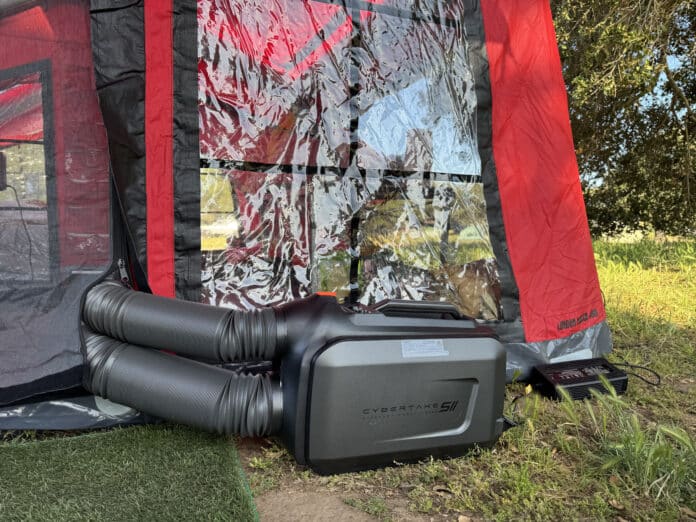
On the 15th afternoon above 90°F in my test stretch, the inflatable family tent felt like a stew pot. Twelve minutes after firing up the Cybertake S2 Pro tent air conditioner, the interior sat at 72°F. After 45 days of repeat testing, my verdict is simple: this is the most thoughtful portable tent air conditioner I have reviewed this year.
The Cybertake S2 Pro is a 5,100 BTU dual-hose unit aimed at tent campers and overlanders. Founded in 2022 in Irvine, California, Cybertake wraps a Panasonic inverter compressor in a 25.57-lb aluminum-alloy body with IPX4 splash protection. However, the unit ships with no built-in battery, which is the single biggest design choice to understand before ordering.
Cybertake skipped the battery to hold weight under 26 lbs and let buyers pick their own power source. Read our portable AC buying guide so the runtime math lines up with the power station you own.
Pricing runs $1,079 on Amazon and $899 direct from Cybertake, so buying direct saves about $180. For an overlander already running an EcoFlow Delta 2 or Bluetti AC200L, the S2 Pro slots in as a serious camping air conditioner without bundling battery cost.
Key Specs at a Glance
| Specification | Details |
|---|---|
| Cooling capacity | 5,100 BTU / 1,500W |
| Heating capacity | 6,100 BTU / 1,800W |
| Coverage area | 107 to 129 sq ft |
| Compressor | Panasonic inverter |
| Refrigerant | R290 hydrocarbon |
| Weight | 25.57 lbs (11.6 kg) |
| Dimensions | 18.90 x 10.24 x 14.02 inches |
| Power input | 48V DC, 12-24V with booster, 100-240V AC |
| Power draw | 100W ECO+ to 600W MAX, 550W startup |
| Runtime | 10 hours per 1 kWh in ECO+ mode |
| Ventilation | Dual hose, 11 cm front, 13 cm rear |
| Noise level | 40 dB minimum, 55 dB on auto |
| Water resistance | IPX4 |
| App control | Fourth Space app, Bluetooth |
| Battery | None included |
| Warranty | 1 year full, 2 years compressor |
| Price | $1,079 Amazon, $899 direct |
Buy on Amazon
Cybertake S2 Pro Portable Air Conditioner
Amazon Prime ships fast with full warranty intact. The manufacturer-direct option runs about $180 less if you prefer to skip Prime shipping.
45-Day Tent Air Conditioner Field Test
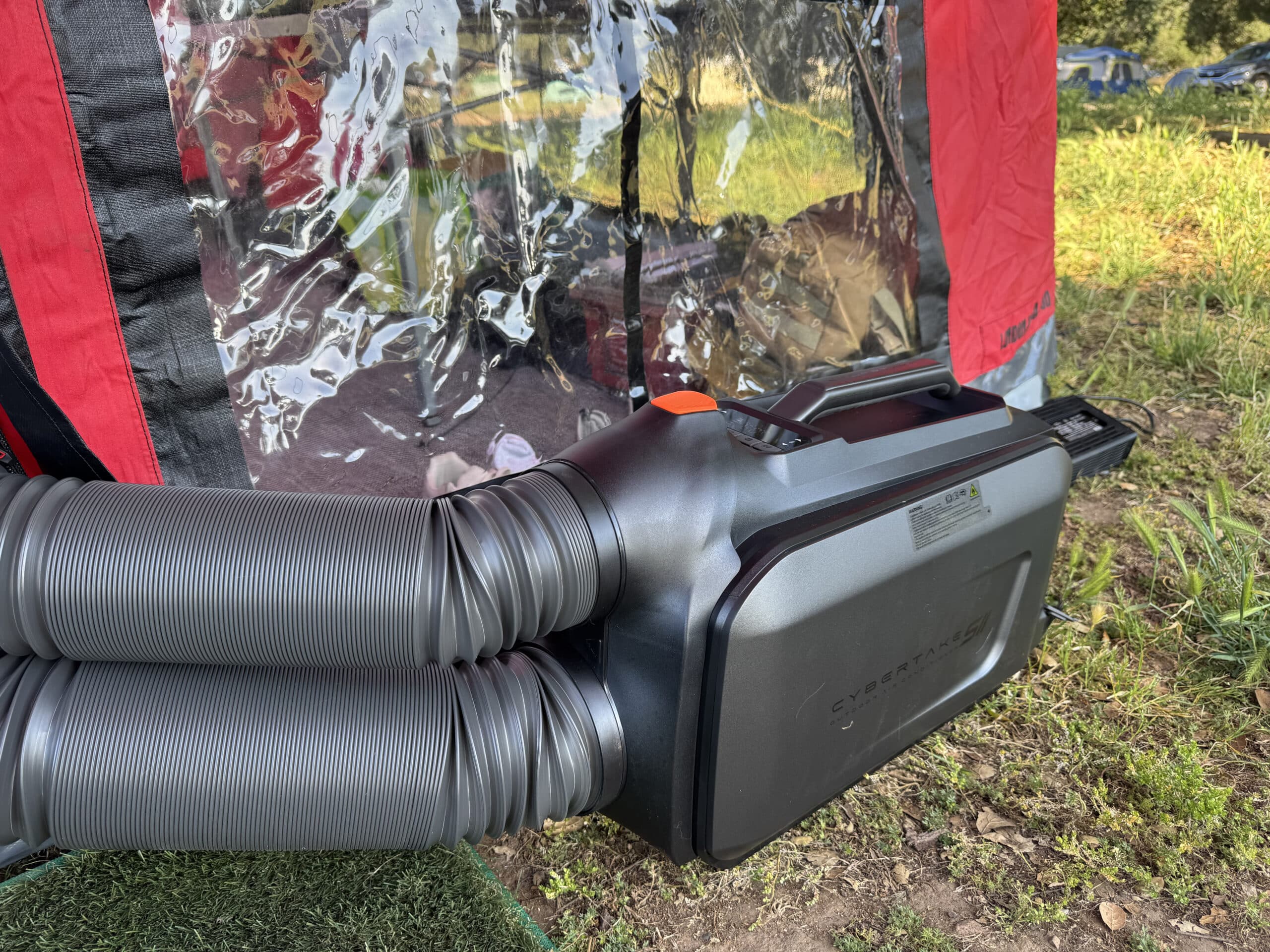
Over 45 days, the S2 Pro went through repeated testing in an inflatable 4-person family tent. Afternoon highs reached the low 90s, while overnight lows dropped into the 60s. Each morning I set the AC on a flat tarp outside the tent, then ran the supply duct in through one window flap and the exhaust out through a second.
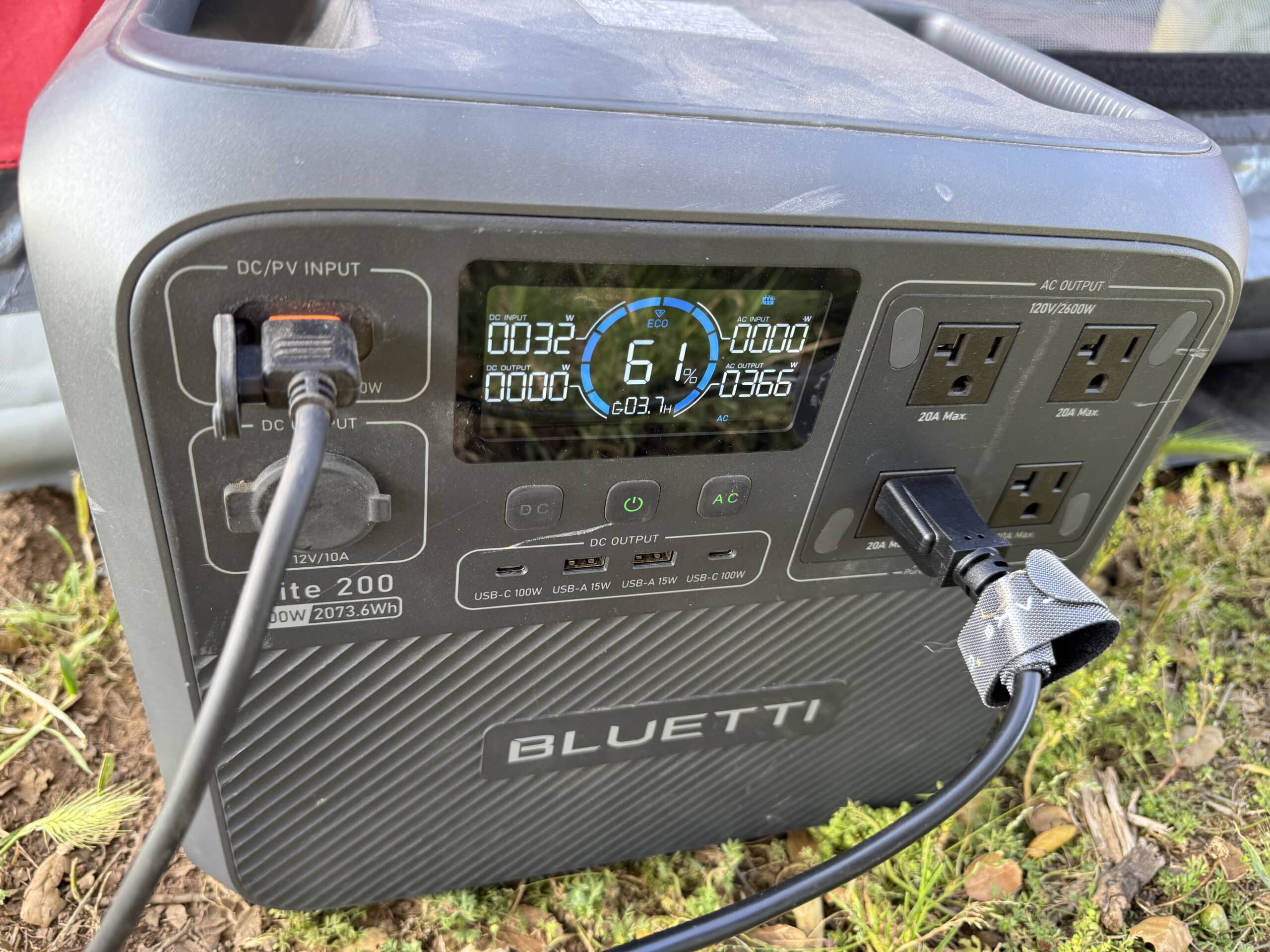
Power came from a 2,000Wh portable power station during off-grid sessions. A 110V outlet handled backyard rehearsals. The unit performed exactly as the manufacturer describes. Cold air came on inside about 60 seconds, and the tent dropped from 88°F to 72°F in roughly 15 minutes under partial shade.
After cool-down, the S2 Pro held set point on ECO+ mode without hard cycling. However, one YouTube reviewer found the unit struggled when placed inside the tent in temperatures above 80°F. My testing confirmed the placement matters. The AC cools far better with the body sitting outside and only the supply duct routed in.
Design is a real strength. The aluminum-alloy chassis feels like overland gear, not an appliance. The molded soft case is the nicest I have unpacked on a portable tent air conditioner this year. Also, the carry handle balances the 25.57 lbs for one-handed loadouts.
Power Draw and the No-Battery Tradeoff
This is the first tent air conditioner battery powered solution I have tested where Cybertake intentionally ships zero battery in the box. The decision shapes every ownership choice after purchase. Cybertake states 100W consumption in ECO+ sleep mode and up to 600W in MAX cooling, with a 550W startup spike.
In real terms, 1 kWh of stored energy delivers about 10 hours of ECO+ runtime or about 2 hours of MAX cooling. My power station tracking matched these numbers within a few percentage points across the 45-day window.
For example, a 2,000Wh power station ran the unit for almost 3 hours on MAX. Then the same station delivered close to 20 hours on ECO+ before voltage dropped below the 36V cutoff. Therefore, overlanders evaluating this as a tent air conditioner battery powered choice should plan for a 1,500Wh minimum, with 2,000Wh as the realistic comfort target.
By contrast, the EcoFlow Wave 2 and Zero Breeze Mark 3 both offer optional integrated batteries. Cybertake pushes that cost onto the buyer. However, this approach also avoids a sealed battery you have to replace after 5 years. Read our take on the portable power station for overlanding before you decide.
Cooling, Noise, and the Dual-Hose System
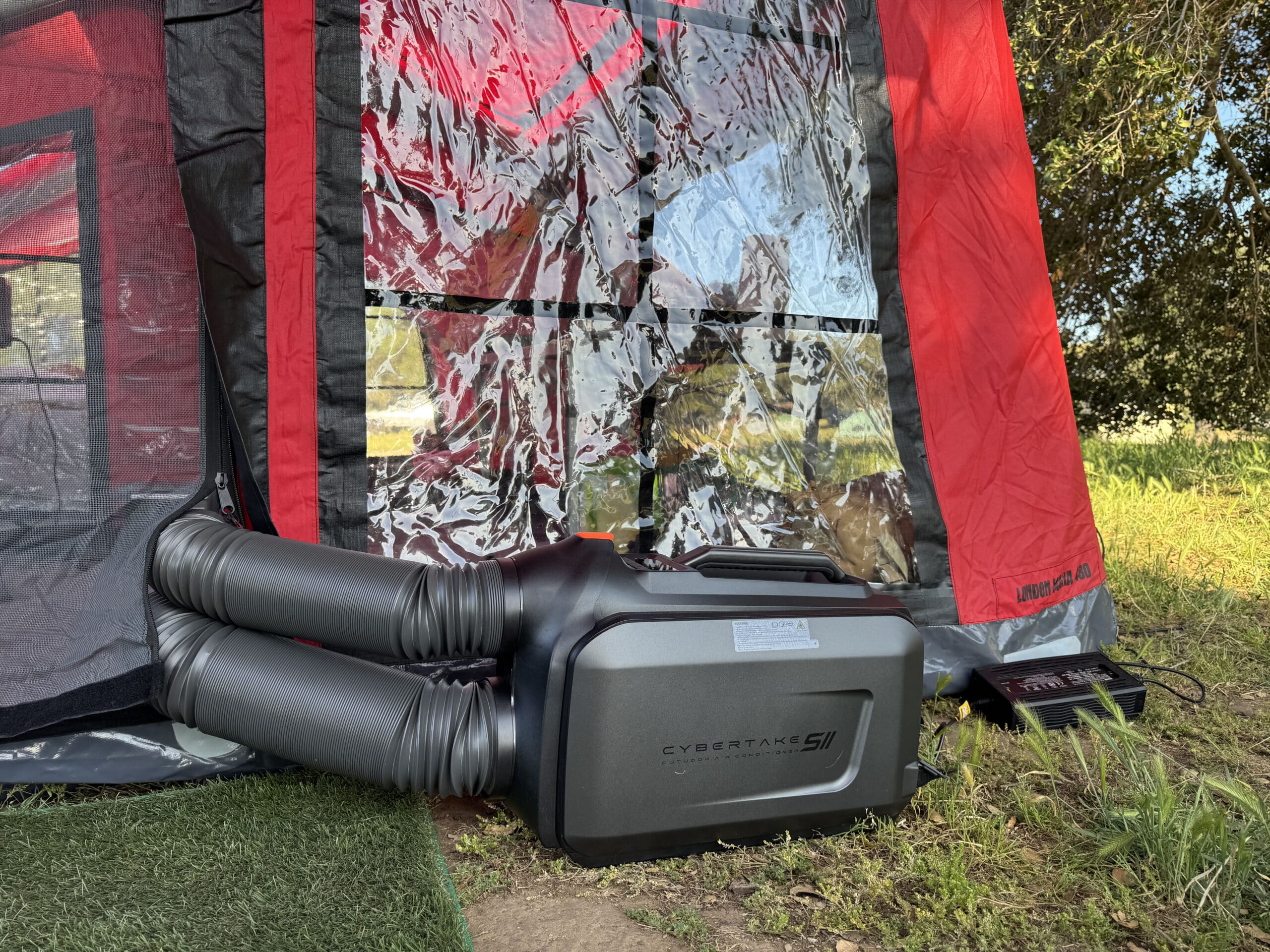
Cooling performance genuinely surprised me. The Panasonic inverter compressor pairs with a true dual-hose ventilation system. Fresh outside air enters through one duct. It runs across the condenser. Finally, hot air exhausts through the second duct.
Cheap portable air conditioners use a single-hose design, so they pull conditioned tent air back out as exhaust. As a result, they create a vacuum effect that draws outside hot air right back into the tent. By contrast, the dual-hose layout sidesteps the issue and runs measurably more efficiently for any tent air conditioner application.
Noise Measurements at Sleep Distance
Noise sits at 40 dB on low fan and climbs to 55 dB on auto. In practice, I measured 48 dB at 3 feet during overnight ECO+ mode. By comparison, my Zero Breeze Mark 3 testing on the same setting ran at 56 dB. Compared to a typical bedroom fan, the Cybertake stays quieter under most modes.
Coverage Area and Tent Sizing
However, the rated coverage of 107 to 129 square feet caps the unit’s headroom. A standard 4-person inflatable tent sits at the upper edge of that envelope. For example, the S2 Pro handles a small 2-person tent or a rooftop tent with room to spare. By contrast, a 6-person family palace will exceed it. Therefore, treat 130 square feet as the hard ceiling for any portable tent air conditioner in this BTU class.
Hose Setup and Daily Use Notes
Setup takes about 5 minutes once you have done it twice. Each extendable hose stretches to 150 cm and clips into the front and rear hood adapters with a quarter-turn lock. The 13 cm rear intake duct and 11 cm front exhaust duct pass through standard tent windows without modification.
The only setup gripe is the stiffer hoses compared to the EcoFlow Wave 2’s softer accordion design. Therefore, collapsing them for packout takes more patience than expected. Also, the power brick deserves a callout. After 45 to 60 minutes of MAX cooling, the adapter brick gets hot enough that Cybertake wraps it in a thick rubber sleeve.
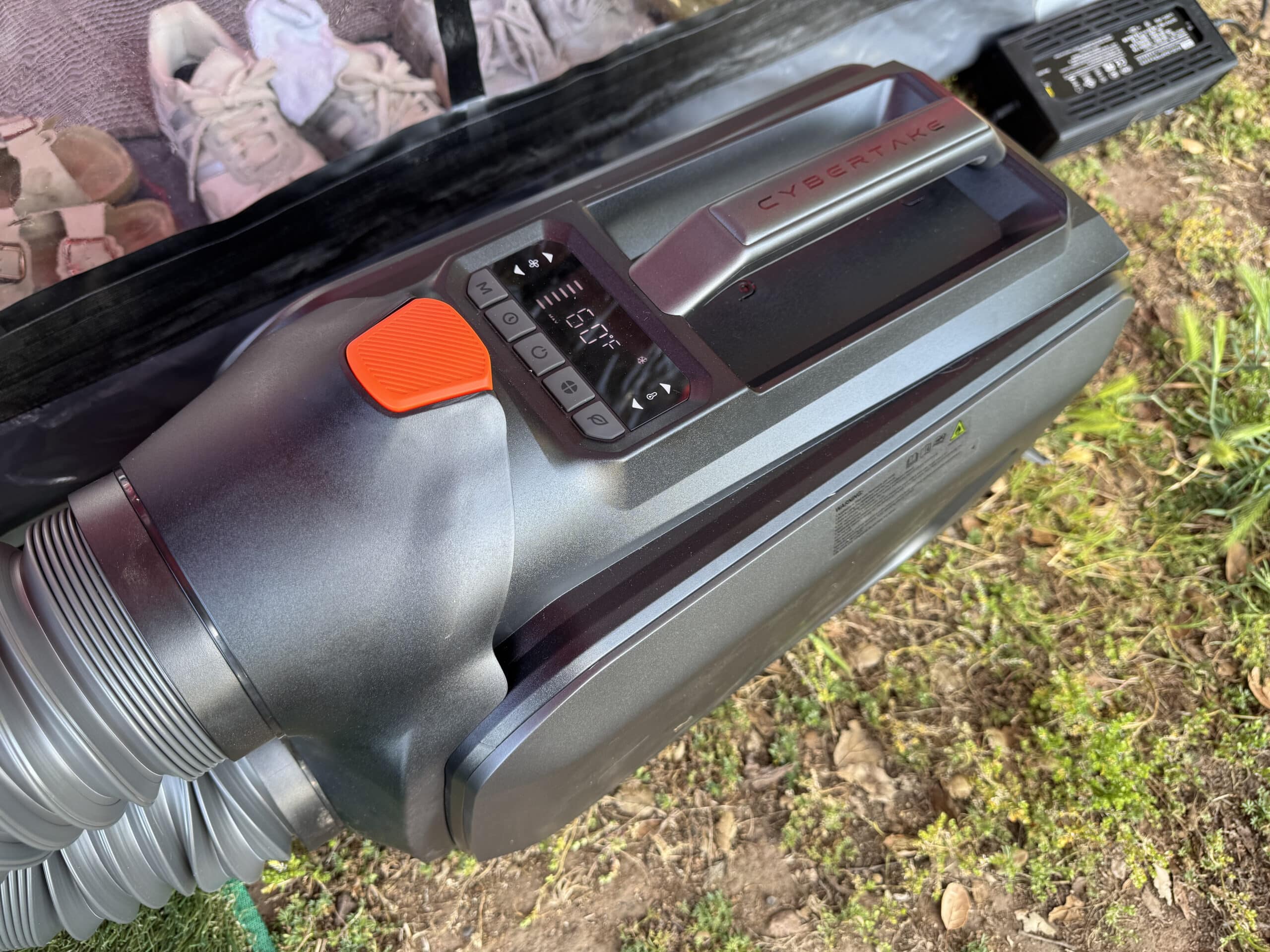
Daily operation runs through onboard buttons, an optional remote sold separately, or the Fourth Space app over Bluetooth. The app sets temperature, switches modes, and programs a 24-hour timer from inside your sleeping bag. For rooftop tent users, this matters because reaching down through a thin tent floor is awkward.
Save on the S2 Pro
Cybertake S2 Pro With Free Prime Shipping
Amazon ships the unit with the 1-year full warranty and 2-year compressor warranty intact. Live pricing changes weekly during peak camping season.
Cybertake vs. EcoFlow Wave 2 and Zero Breeze Mark 3
I have tested all three units head-to-head, so the comparison comes from direct experience rather than spec-sheet math. On weight, the Zero Breeze Mark 3 is the lightest at about 22 lbs. The Cybertake S2 Pro sits in the middle at 25.57 lbs. By contrast, the EcoFlow Wave 2 weighs about 32 lbs without its battery and over 50 lbs with the add-on pack.
On cooling output, the S2 Pro’s 5,100 BTU lands almost identical to the EcoFlow Wave 2’s 5,100 BTU rating and slightly below the Zero Breeze Mark 3’s 5,280 BTU. So all three sit in the same cooling tier. The real differentiator is power philosophy. The Wave 2 pairs with a $1,000 optional 1,159Wh battery for plug-and-play camping. Likewise, the Zero Breeze Mark 3 offers a 23-lb add-on battery for about $1,000.
The Cybertake takes the opposite path: skip the battery, run off any 48V-compatible power station you already own. On a 92°F afternoon, the Wave 2 and the S2 Pro both hit a 72°F set point within two minutes of each other. However, the S2 Pro drew about 15 percent less wattage on ECO+ mode to maintain the set point. Read our EcoFlow Wave 2 review and our Zero Breeze Mark II review for the full picture on each competitor.
On year-round comfort, the S2 Pro and the Wave 2 both offer integrated heating modes. Each rates about 6,100 BTU of heat, so the heating tier is a near tie. The Mark 3 is cooling-only. For the best portable AC for tent shoppers who camp into shoulder season, the Cybertake or the Wave 2 are the only serious picks. See our rooftop tent camping essentials roundup for the broader kit context.
Pros and Cons
Pros
- 5,100 BTU cooling plus 6,100 BTU auxiliary heating in one 25.57-lb body
- True dual-hose ventilation runs more efficiently than single-hose competitors
- Panasonic inverter compressor cycles smoothly with no harsh on-off jolt
- 40 dB low fan setting is among the quietest I measured in this BTU class
- 100W ECO+ draw delivers 10 hours of runtime per kWh of stored energy
- Aluminum-alloy chassis with IPX4 splash protection and 50 cm drop testing
- Fourth Space app over Bluetooth controls the unit from your sleeping bag
- Direct pricing of $899 saves about $180 versus the Amazon listing
- Auxiliary heating extends shoulder-season camping into late fall and early spring
Cons
- No built-in battery, so you need a 1,500Wh or larger portable power station
- Hoses are stiffer than the EcoFlow Wave 2 and harder to collapse for packout
- Coverage caps at 129 sq ft, so larger family tents exceed the envelope
- AC-to-DC power brick runs hot under MAX loads beyond 45 minutes
- Heating mode requires ambient temperature at or above 50°F to operate safely
- Performance dips above 80°F when the unit sits inside the tent
- Remote control is sold separately, not bundled with the base SKU
Final Verdict
For overlanders and rooftop tent campers already running a quality power station, the Cybertake S2 Pro is the smartest camping air conditioner launch I have tested in 2026. The combination of dual-hose efficiency, 40 dB sleep mode, and Panasonic inverter performance hits a sweet spot at the $899 direct price.
However, the no-battery design is a real tradeoff. Buyers without a 1,500Wh station spend $1,000 to $2,000 building the off-grid stack. So if you are starting from zero, the EcoFlow Wave 2 with its add-on battery is the simpler one-purchase decision.
For tent campers who want real summer cooling with the option of shoulder-season heat, the S2 Pro lands as my top recommendation. Above all, as a roof top tent air conditioner for an established overland build, it is the most efficient pick this season.
Ready to Buy?
Check Today’s Price on the Cybertake S2 Pro
Amazon ships with Prime delivery and the full 1-year warranty. Manufacturer-direct runs about $180 less at the time of writing. Cross-reference specs on the official Cybertake spec sheet before you commit.
Frequently Asked Questions
Does the Cybertake S2 Pro air condition a tent effectively?
Yes. The unit cools a sealed tent up to 129 sq ft from 88°F to 72°F in about 15 minutes when placed outside. For larger family tents in direct sun, cooling plateaus at higher set points.
Is the Cybertake S2 Pro a tent air conditioner battery powered solution?
No. The unit does not include a battery. Instead, you supply power from a 48V-compatible portable power station, a 12-24V vehicle outlet with the booster accessory, or a 100-240V wall outlet. Plan for a 1,500Wh power station to get a full overnight session.
What is the best portable AC for tent camping in 2026?
The S2 Pro leads on year-round versatility with cooling and heating in one box. Meanwhile, the EcoFlow Wave 2 is the simpler pick if you want an integrated battery option. Notably, the Zero Breeze Mark 3 still works for ultralight backpackers prioritizing weight.
How does the Cybertake work as a roof top tent air conditioner?
The unit sits on the vehicle roof rack or on a ground tarp below the rooftop tent. The dual hoses run up through the tent annex zipper. Above all, the 40 dB sleep mode and Fourth Space app control help rooftop tent users avoid reaching down mid-night.
Does the Cybertake beat the Zero Breeze tent air conditioner?
On most metrics, yes. The Zero Breeze Mark 3 is about 3 lbs lighter, but the Cybertake offers heating, lower noise, and dual-hose efficiency. Cooling output sits within 180 BTU of each other, so real-world heat-loss favors the dual-hose Cybertake.
Does the S2 Pro need a tent with air conditioner port?
Not specifically. The 11 cm and 13 cm hoses pass through most standard tent windows or annex zippers without modification. A dedicated AC port makes integration cleaner. Still, a port is not a requirement for the unit to work.