


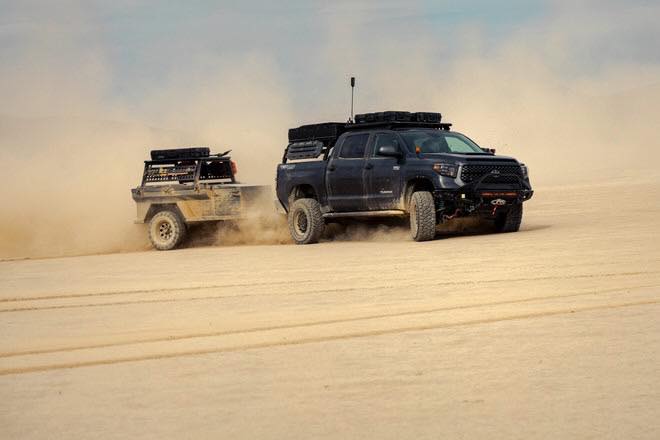

Quick Verdict: Your off-road trailer suspension determines ride quality, ground clearance, load capacity, and trail capability. Leaf springs handle heavy loads affordably but ride rough unloaded and offer low ground clearance. Torsion axles ride smooth on pavement but lack articulation for serious off-road work. Independent coil-over systems provide the best all-around trail performance at a premium price. Axle-less trailing arm systems (like the Timbren HD used on Rustic Mountain Overland trailers) deliver the highest ground clearance with independent wheel travel, making them the top choice for dedicated off-road trailer builds.
Last updated: April 2026 | 10 min read
Written by the 4WDTalk team. We have towed trailers on every suspension type covered in this guide across Southern California mountain trails, Big Bear fire roads, and Alabama backroads during photo shoots with Rustic Mountain Overland. Tow vehicles ranged from midsize trucks (2020 Jeep Gladiator, 2025 Chevy Colorado ZR2) to half-ton pickups (RAM 1500) to 3/4-ton haulers (Chevy Silverado 2500). When your tow rig changes every few months, you learn fast how suspension reacts differently behind each vehicle.
In This Guide
- Why Suspension Matters More Than You Think
- Side-by-Side Suspension Comparison
- Leaf Spring Suspension
- Torsion Axle Suspension
- Independent Coil-Over Suspension
- Axle-Less Trailing Arm Suspension
- Matching Suspension to Your Terrain
- Load Capacity and Weight Ratings
- Maintenance and Long-Term Costs
- Final Verdict
- Frequently Asked Questions
Why Suspension Matters More Than You Think

Three miles into a rocky desert wash, your trailer bottoms out on a ledge. The leaf spring axle catches, bends, and your rig sits crooked in the middle of nowhere with no cell signal and no spare axle. In fact, we have watched this scenario play out firsthand on fire roads outside Big Bear and across BLM land throughout the West. Your off-road trailer suspension does two jobs: it absorbs impacts from rocks, ruts, and washboard roads, and it keeps your wheels in contact with the ground for traction and steering stability. If the suspension loses contact with the terrain, the trailer skips sideways, damages cargo, and pulls your tow vehicle off line. Building a purpose-built off-road trailer matched to your suspension needs is crucial for serious overlanders.
I have towed and tested a number of different trailers over the years and I will say this… most factory utility trailers come with leaf springs or torsion axles rated for highway use. These systems work fine on paved roads and graded gravel, but they fail on rough terrain where wheel travel, articulation, and ground clearance determine whether you pass or get stuck. Understanding the four major trailer suspension types helps you choose the right system for your terrain, load, and budget before committing to a trailer purchase.
Looking for a trailer built on proven off-road suspension? Rustic Mountain Overland builds all-steel trailers on Timbren HD axle-less suspension rated for serious trail use.
Side-by-Side Suspension Comparison
| Factor | Leaf Spring | Torsion Axle | Coil-Over Independent | Axle-Less Trailing Arm |
|---|---|---|---|---|
| Ground Clearance | Low (axle hangs below frame) | Moderate | High | Highest (no through-axle) |
| Wheel Travel | 2-4 inches | 2-3 inches | 6-10+ inches | 4-6 inches |
| Load Capacity Range | 1,000-10,000+ lbs | 1,000-8,000 lbs | 2,000-5,000 lbs | 400-7,000 lbs |
| Ride Quality (Loaded) | Good | Strong | Excellent | Excellent |
| Ride Quality (Empty) | Poor (bouncy) | Good | Good | Good |
| Off-Road Capability | Basic | Basic-Moderate | Advanced | Advanced |
| Cost (Per Axle) | $200-$600 | $400-$900 | $2,000-$5,000+ | $800-$1,700 |
| Field Repairability | Excellent (parts everywhere) | Poor (replace whole unit) | Moderate (specialty parts) | Good (modular design) |
Leaf Spring Suspension
You will find leaf springs on more trailers than every other suspension type combined. Essentially, a stack of curved steel plates (leaves) bolted between the axle and frame flex under load to absorb bumps. For the leaf spring vs torsion trailer debate, leaf springs win on load capacity, repairability, and cost. They handle 1,000-10,000+ lbs depending on the number and thickness of leaves, and replacement springs cost $50-$150 per set from any trailer parts supplier.
However, leaf springs have serious limitations for off-road use. The solid through-axle hangs below the frame, reducing ground clearance by 4-6 inches compared to axle-less designs. On one trip near Big Bear, a leaf-sprung utility trailer we towed caught a ledge so hard it tweaked the frame. The exposed axle tube catches on obstacles and bends or breaks on rocky terrain. Also, leaf springs ride rough when unloaded because the spring rate stays the same regardless of weight. This “harmonic bounce” at highway speeds causes cargo damage, trailer sway, and accelerated wear on mounting hardware.
Best for: Heavy-duty utility trailers, flatbeds, enclosed cargo trailers used primarily on roads and graded trails. Budget builds where parts availability and simple repairs matter most.
Torsion Axle Suspension
Where leaf springs flex metal, torsion axles compress rubber. Rubber cords encased in a steel tube absorb road impacts, and each wheel operates independently; when one side hits a bump, only the cord on the affected side compresses. This independent trailer suspension design eliminates the solid axle beam, resulting in a smoother highway ride than leaf springs and less trailer sway during lane changes or crosswinds.
For pavement-focused overlanding rigs pulling between campgrounds on paved or well-maintained gravel roads, torsion axles offer a good balance of ride quality and durability. Behind our RAM 1500 on Interstate 15 heading to Big Bear, a torsion-equipped trailer tracked straight and quiet. But the moment we turned onto a rutted forest service road, the difference was obvious. However, torsion axles provide only 2-3 inches of wheel travel. On rough trails with large rocks, deep ruts, or uneven terrain, the limited travel means the wheels lose ground contact quickly. Because the rubber cords degrade over time (especially in extreme heat or cold), torsion axles eventually need complete replacement rather than individual component rebuilds.
In the leaf spring vs torsion trailer comparison, torsion wins on ride comfort and reduced maintenance for on-road use. Leaf springs win on heavy-load capacity, field repairability, and cost. Neither system excels as an off-road trailer suspension for serious backcountry work.
Featured on Rustic Mountain Overland
Patrol XC: Built on Timbren HD Axle-Less Suspension
All-steel construction with 2,200 lb Timbren suspension, 31″ AT tires, and Lock-N-Roll hitch. Made in the USA.
Independent Coil-Over Suspension
If budget is secondary to trail performance, independent coil-over systems are the top tier. A trailing arm or A-arm connects each wheel hub to the frame, paired with a coil spring and shock absorber (often a combined coil-over unit). Systems like the Cruisemaster CRS2 and similar trailing-arm setups deliver 6-10+ inches of wheel travel, keeping both wheels in contact with the ground over obstacles and ruts instead of lifting a wheel into the air.
This off-road trailer axle configuration is the top choice for expedition-grade trailers. The long wheel travel absorbs impacts before they reach the frame, protecting cargo and reducing fatigue on the tow vehicle hitch. Notably, independent coil-over systems prevent the “trailer bounce” problem where a solid-axle trailer oscillates at speed on washboard roads. Instead, each wheel responds to its own terrain independently, keeping the trailer level and stable.
The downsides are cost and complexity. A quality coil-over independent setup costs $2,000-$5,000+ per axle, compared to $200-$600 for leaf springs. Components are also specialized; if a control arm bends on a remote trail, you will not find a replacement at the nearest farm supply store. For this reason, coil-over systems suit purpose-built expedition trailers where performance justifies the investment.
Axle-Less Trailing Arm Suspension
Remove the through-axle entirely, and you get the newest approach to off-road trailer suspension. These systems use two modules bolted to the trailer frame, each with a trailing arm and rubber spring elements (Timbren’s Aeon rubber springs are the industry standard). With no solid beam connecting the two wheels, ground clearance increases dramatically because there is nothing to catch on rocks or ledges between the wheels.
Timbren’s axle-less trailer suspension is the dominant product in this category, offering capacity ratings from 400 lbs to 7,000 lbs per pair. The HD 2,200 lb model is the most popular for overland trailers. We towed Rustic Mountain Overland’s Patrol XC on this setup across Alabama backroads during photo shoots and through Southern California mountain trails behind a 2025 Colorado ZR2 and a Gladiator. The difference compared to leaf springs was immediate: the trailer tracked flat over washboard sections where a leaf-sprung trailer would have been bouncing sideways. It handles rough terrain with 4-6 inches of independent wheel travel while maintaining a stable, low-bounce ride at highway speeds. Installation requires basic tools and bolts directly to a flat trailer frame rail, making it one of the simpler off-road trailer suspension upgrades for custom builds.
Compared to coil-over systems, axle-less trailing arms cost less ($800-$1,700 per pair) and require less maintenance since the rubber Aeon springs have no moving parts to wear or leak. Conversely, axle-less systems provide less total wheel travel (4-6 inches versus 6-10+ inches for coil-overs), which limits performance on extreme rock crawling trails. For the majority of overlanding terrain including desert washes, forest roads, mountain passes, and washboard, the axle-less design delivers outstanding performance at a mid-range price point.
Matching Suspension to Your Terrain

Choosing the right off-road trailer suspension means matching the system to the most demanding terrain you regularly encounter, not the average conditions. For example, a trailer running 90% highway and 10% gravel forest roads needs different suspension than one running 50% rocky desert trails and mountain passes.
On highway and graded gravel routes (campground-to-campground touring), a torsion axle or leaf spring setup handles the job at the lowest cost. Add helper springs or a weight-distribution hitch to improve loaded highway stability. Meanwhile, moderate off-road use (forest service roads, desert two-tracks, BLM land) calls for an axle-less trailing arm system, which provides the ground clearance and independent wheel travel needed to avoid damage without breaking the budget.
On advanced off-road terrain (rock crawling approaches, deep sand washes, steep mountain switchbacks with erosion), an independent coil-over or high-end axle-less system is worth the investment. Ask me how I know that! We learned this towing through the San Bernardino Mountains behind a Silverado 2500; the axle-less Timbren setup on the Rustic Mountain trailer handled switchbacks and erosion ruts without a single scrape on the undercarriage. The extended wheel travel keeps both wheels planted on uneven terrain, and the superior ground clearance prevents frame and axle damage on rocky obstacles. Many overlanders invest in premium suspension systems to handle the demanding conditions reliably. Regardless of suspension type, also match your tires to the terrain. A 31-33 inch all-terrain tire with at least a D load rating complements any off-road trailer axle configuration.
Load Capacity and Weight Ratings
Every off-road trailer suspension system has two ratings: GAWR (Gross Axle Weight Rating) and dynamic load rating. GAWR is the maximum static weight the axle supports while parked. The dynamic rating, which is lower, reflects the maximum load during driving when impacts multiply the effective weight by 2-3x. Especially for off-road use, the dynamic rating matters more than the static number because trail impacts amplify loads beyond what the scale shows in your driveway.
Leaf springs offer the widest range of trailer suspension types rated for heavy loads (1,000-10,000+ lbs), making them the default for heavy cargo trailers. Torsion axles top out around 8,000 lbs for tandem setups. Meanwhile, the Timbren axle-less system rates up to 7,000 lbs per pair, covering the weight range of most overland trailers (1,500-4,000 lbs loaded). Independent coil-over systems typically support 2,000-5,000 lbs, focusing on the expedition trailer segment.
Therefore, when calculating your required suspension capacity, add your trailer dry weight, water (8.3 lbs per gallon), gear, fuel, and recovery equipment. Then add a 20% safety margin. A 1,500 lb dry-weight off-road trailer loaded with 300 lbs of water, 400 lbs of gear, and a 20% margin needs a suspension rated for at least 2,640 lbs. Under-rating your off-road trailer suspension leads to bottoming out, premature wear, and dangerous handling on descents.
Maintenance and Long-Term Costs

Leaf springs require the most routine attention among all trailer suspension types. Inspect the U-bolts, shackles, and bushings every 5,000 miles or after every off-road trip. Then replace worn bushings ($20-$40 per set) and cracked leaves ($50-$150 per spring pack) before they fail on the trail. The upside: any trailer shop or farm supply store stocks leaf spring components, and field repairs are straightforward with basic hand tools.
Torsion axles need the least routine maintenance since the rubber cords are sealed inside the axle tube. However, once the rubber degrades (typically after 8-10 years of use), the entire axle assembly requires replacement at $400-$900. Field repair is essentially impossible because the internal components are not serviceable individually.
For this independent trailer suspension category, maintenance falls in the middle. The Timbren Aeon rubber springs have no moving parts and resist UV, oil, and temperature degradation. Inspect the mounting bolts and arm pivot points annually, and check tire wear patterns for signs of misalignment. If a rubber spring element needs replacement, you swap the module rather than the entire system, keeping costs at $300-$600 per side.
Independent coil-over systems need regular shock absorber inspection and replacement (every 30,000-50,000 miles, $100-$300 per shock). Similarly, check control arm bushings, ball joints, and mounting hardware after off-road trips. Budget $500-$1,500 for a full rebuild at 50,000 miles. The higher maintenance cost reflects the more complex engineering delivering superior ride quality.
Featured on Rustic Mountain Overland
All-Steel Off-Road Trailers, Made in the USA
Patrol XC and XCT models feature Timbren HD 2,200 lb axle-less suspension, 31″ AT tires, and all-steel fabrication from Irondale, Alabama.
Final Verdict
The best off-road trailer suspension depends on where you drive and how much you load. Leaf springs win for heavy-duty utility trailers staying on roads. Torsion axles suit campground-to-campground touring on paved routes. For overlanders running forest roads, desert washes, and mountain trails at moderate to advanced difficulty, axle-less trailing arm systems (particularly the Timbren HD) deliver the best balance of ground clearance, independent wheel travel, durability, and value. Full independent coil-over systems remain the top performers for extreme terrain at a premium price. If you are looking to upgrade your current setup, reviewing the best off-road campers shows how different manufacturers approach suspension integration.
Before buying any trailer, ask the manufacturer exactly what suspension it runs and what the GAWR and dynamic ratings are. We have seen gorgeous trailers with full kitchens and rooftop tents sitting on bargain-bin leaf springs, and they all end up the same way: bent frames and broken gear after one serious trail day. Rustic Mountain Overland builds their Patrol XC and XCT on Timbren HD 2,200 lb axle-less suspension with 31″ AT tires, providing a proven off-road trailer axle platform for overlanding.
Frequently Asked Questions
What suspension is best for off-road trailers?
For most overlanding use, axle-less trailing arm systems (like the Timbren HD) offer the best combination of ground clearance, independent wheel travel, and durability at a reasonable price. Independent coil-over systems provide more wheel travel for extreme terrain but cost 2-3x more and require more maintenance.
Are torsion axles good for off-road?
Torsion axles work for light off-road use on graded gravel and forest roads, but they fall short as a dedicated off-road trailer suspension. They provide a smooth highway ride and low maintenance. However, their limited 2-3 inches of wheel travel and sealed, non-rebuildable design make them a poor choice for rough trails where impacts exceed their absorption capacity. Look at axle-less or independent coil-over systems instead for serious trail use.
How much wheel travel do I need for off-road?
Aim for at least 4 inches of wheel travel for moderate off-road use (forest roads, desert two-tracks). For rock crawling approaches and extreme terrain, 6-10 inches of travel keeps both wheels planted and prevents the trailer from skipping sideways on obstacles. Leaf springs provide only 2-4 inches, while independent coil-over systems deliver 6-10+ inches.
Do leaf springs or torsion axles last longer?
Leaf springs last longer because individual components (springs, bushings, shackles) are replaceable. A well-maintained leaf spring setup runs 100,000+ miles with periodic bushing and spring replacements. Torsion axles last 8-10 years before the internal rubber cords degrade, at which point the entire axle requires replacement since individual parts are not serviceable.
What is an axle-less trailer suspension?
An axle-less trailer suspension replaces the traditional through-axle beam with two independent modules bolted to the trailer frame. Each module uses a trailing arm with rubber spring elements to support and suspend one wheel. With no beam connecting the wheels, ground clearance increases because nothing hangs below the frame between the tires. Timbren is the leading manufacturer, offering models rated from 400 to 7,000 lbs.
📷 Image Notes — Remove Before Publishing
- Hero: Side-by-side comparison of different trailer suspension types (leaf spring, torsion, coil-over, axle-less)
Search Shutterstock - In-use: Off-road trailer navigating rocky terrain showing suspension articulation
Search Shutterstock - Detail: Close-up of Timbren axle-less suspension module on trailer frame
Search Shutterstock - Detail: Leaf spring suspension showing U-bolts, shackles, and axle
Search Shutterstock - Comparison: Coil-over independent suspension with trailing arm on expedition trailer
Search Shutterstock - Context: Overland trailer on mountain trail showing ground clearance
Search Shutterstock