



Quick Facts:
- Vehicle: 2027 Toyota Tundra TRD Hammer (anticipated)
- Status: Trademark filed; camouflaged prototypes spotted testing
- Expected engine: Twin-turbo 3.4-liter V6 hybrid
- Rumored output: Around 510 hp and 620 lb-ft
- Off-road hardware: Fox shocks, widebody fenders, roughly 37-inch tires
- Estimated price: High-$70,000s to low-$80,000s
- Expected reveal: Late 2026, as a 2027 model
- Main rival: Ford F-150 Raptor R
- Best for: Off-road buyers waiting on a factory desert runner from Toyota
8 min read
In This Article
Toyota Tundra TRD Hammer Overview: Toyota’s Answer to the Raptor
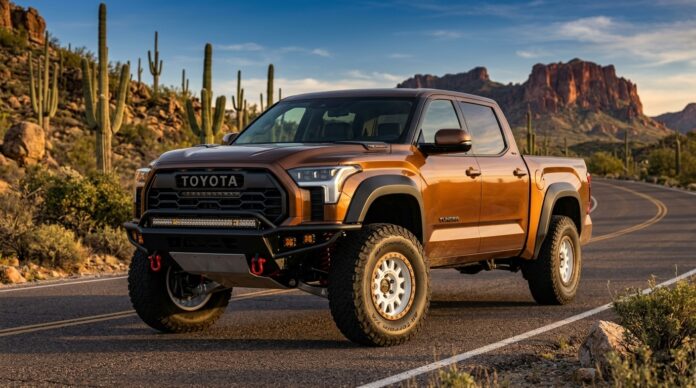
The 2027 Toyota Tundra TRD Hammer is the truck off-road buyers have wanted from Toyota for years. Toyota filed a trademark for the TRD Hammer name in March 2026, and camouflaged prototypes have since appeared on public roads wearing widebody fenders and oversized tires. The brand has teased a Raptor-fighting Tundra before, so the trademark filing reads as the clearest sign yet of a real production plan.
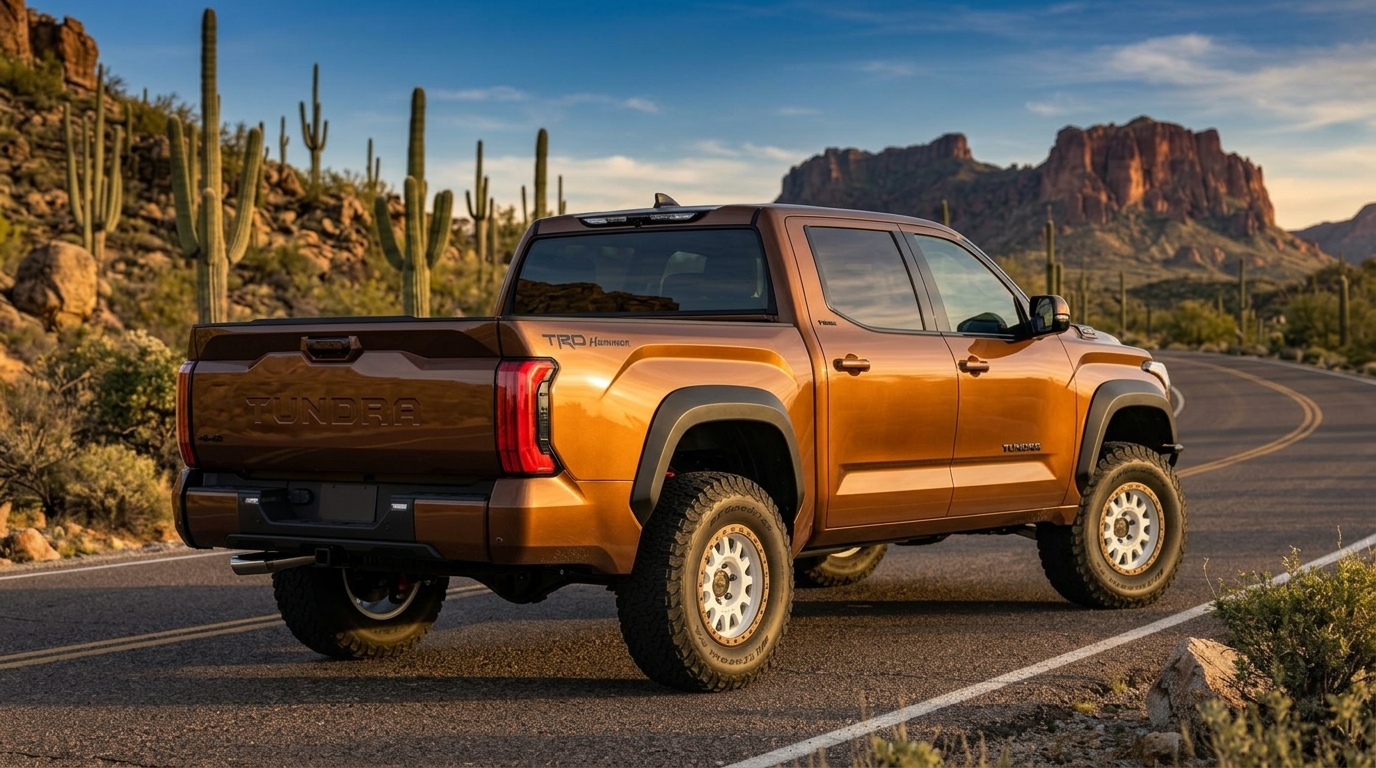
Toyota already sells the Tundra TRD Pro, a capable off-road trim with a lifted suspension and a hybrid V6 engine. However, the TRD Pro favors graded trails and forest roads over high-speed desert running. The Hammer would push the formula toward outright speed. Spy photos show prototypes on roughly 37-inch tires with steel bumpers and reworked suspension, hardware aimed at the same terrain the Ford Raptor attacks best.
I have owned a Jeep Gladiator and a Chevy Colorado ZR2, and I rented a Bronco Badlands for a week of desert trails. A Toyota has never sat in my driveway. The Tundra TRD Hammer, with rumored pricing in the low-$80,000s, is the first one I would gladly go pick up. Below, this guide sorts the confirmed details from the rumors and measures the Hammer against the Ford F-150 Raptor R.
Toyota Tundra TRD Hammer Specs: Confirmed and Rumored
Toyota has confirmed surprisingly little on paper. Most of what enthusiasts know comes from trademark filings, spy photography, and one high-profile race result. The table below sorts solid evidence from educated guesses, so you see where the Hammer stands today. Treat every “expected” and “rumored” line about the Toyota Tundra TRD Hammer as a moving target until Toyota speaks.
| Detail | What We Know |
|---|---|
| TRD Hammer name | Trademark filed with the USPTO in March 2026 (confirmed) |
| Body and stance | Widebody fenders and a wider track (spy-photo evidence) |
| Tires | Roughly 37-inch all-terrains, up from 33 inches (spy-photo evidence) |
| Engine | Twin-turbo 3.4-liter V6 hybrid, carried over (expected) |
| Output | Around 510 hp and 620 lb-ft, up from 437 hp (rumored) |
| Suspension | Fox internal-bypass shocks with extra wheel travel (rumored) |
| Estimated price | High-$70,000s to low-$80,000s (estimated) |
| Reveal | Late 2026, as a 2027 model (expected) |
The Powertrain Question: Hybrid Muscle Over a V8
The most surprising part of the Hammer is what it leaves out. Toyota dropped the V8 from the Tundra lineup in 2022, replacing it with the i-Force MAX, a twin-turbo 3.4-liter V6 hybrid now standard across Toyota’s Tundra range. In the current TRD Pro, the i-Force MAX produces 437 hp and 583 lb-ft of torque. For an off-road truck, the 583 lb-ft figure matters more than peak horsepower.
Reports suggest Toyota would push the engine higher for the Toyota Tundra TRD Hammer, with estimates near 510 hp and 620 lb-ft. Treat those numbers as rumor for now. Even the standard 437-hp version sits only slightly below the 450-hp V6 Ford Raptor, so the rumored figure would clear it comfortably.
Why a Hybrid Makes Sense in the Desert
A hybrid drivetrain brings two real advantages off-road. First, the electric motor delivers torque the instant you touch the throttle, which helps with low-speed crawling and launches out of soft sand. Second, the electric assist fills turbo lag, so throttle response stays sharp during quick corrections at speed. Toyota gains a packaging benefit too, because the battery sits low and drops the center of gravity. The open question is heat. Desert running punishes cooling systems hard, and a hybrid adds a battery plus a motor to the thermal load. Toyota appears confident anyway.
The Hammer’s Suspension and Off-Road Hardware
Spy photos give the clearest read on the Hammer’s off-road hardware. Prototypes wear widebody fenders, a wider track, and roughly 37-inch all-terrain tires. For comparison, the current TRD Pro rolls on 33-inch tires. The jump to 37s signals a real change of mission, because bigger tires demand more wheel travel, more clearance, and stronger axles.
Industry reports point to Fox internal-bypass shocks with extra travel at both ends. The Ford Raptor uses a similar Fox setup, so Toyota would be matching a proven formula rather than inventing one. Steel high-clearance bumpers also appear on the prototypes, which sharpen approach and departure angles on technical ground. Toyota already offers a factory TRD lift kit for the Tundra, so the brand has been moving toward serious off-road hardware for a while.
One detail still missing is chassis reinforcement. Desert trucks need stiffer frames and stronger mounting points to survive repeated hard landings. Toyota has not shown the frame work yet. Still, one race result suggests the engineering runs further along than the camouflage lets on.
The Mint 400 Proving Ground
The strongest signal of Toyota’s intent did not arrive in a press release. It arrived at a race. In March 2026, Toyota entered a hybrid Tundra in the Mint 400, one of the largest and most prestigious off-road races in North America. The truck, known internally as H111, finished its run. No hybrid had completed the event before, which made the result a genuine milestone.
Earlier, Toyota had floated the idea publicly with the Tundra Desert Chase concept. The race entry turned a styling exercise into hard proof. For a desert race built to break trucks, simply finishing counts as the headline.
The result matters for two reasons. First, it shows the hybrid powertrain survives sustained desert abuse, the exact durability concern raised earlier. Second, it hands Toyota real test data months before the Toyota Tundra TRD Hammer reaches dealers. Ford and Ram both used desert racing to develop the Raptor and the TRX, so Toyota is following a proven path rather than guessing.
Toyota Tundra TRD Hammer vs Ford F-150 Raptor R
Here is the honest framing. The Toyota Tundra TRD Hammer and the Ford F-150 Raptor R do not match on a spec sheet. Ford’s Raptor R runs a supercharged 5.2-liter V8 worth 720 hp. Even a 510-hp Hammer trails it by more than 200 hp. So why line them up? Because the Raptor R is the benchmark every desert truck gets measured against, and Toyota wants a piece of the same audience.
| Specification | Tundra TRD Hammer | Ford F-150 Raptor R |
|---|---|---|
| Engine | Twin-turbo 3.4L V6 hybrid | Supercharged 5.2L V8 |
| Horsepower | About 510 hp (rumored) | 720 hp |
| Torque | About 620 lb-ft (rumored) | 640 lb-ft |
| Tires | Roughly 37-inch (spy photos) | 37-inch |
| Suspension | Fox shocks (expected) | Fox Live Valve shocks |
| Starting price | High-$70,000s to low-$80,000s (estimated) | North of $110,000 |
| Availability | Reveal expected late 2026 | On sale now |
Where the Hammer Wins
Price leads the Hammer’s case. A low-$80,000s sticker would undercut the Raptor R by more than $30,000. For most buyers, the gap funds years of fuel, tires, and trail trips. The hybrid V6 also sips less fuel than the supercharged V8, which helps on long overland routes between gas stations. Toyota’s resale strength adds a third edge, since Tundra and Tacoma values consistently top the segment.
Where the Raptor R Still Leads
The Raptor R answers with raw force. 720 hp and a deep V8 soundtrack deliver a sensation no hybrid V6 reproduces. Ford also brings a decade of Raptor development, including three chassis generations and the long-running Raptor versus TRX rivalry. Toyota would enter the segment with its first true attempt, so the Hammer has to prove itself against a known quantity. For buyers chasing the loudest, fastest factory truck regardless of cost, the Raptor R keeps the crown.
Final Verdict
The Toyota Tundra TRD Hammer is shaping up as the most credible Raptor rival Toyota has ever built. Hard evidence backs it: a filed trademark, widebody prototypes on 37-inch tires, and a hybrid Tundra finishing one of North America’s toughest desert races. For off-road buyers who want factory desert capability without a six-figure price, the Hammer looks like the answer.
It is not for everyone, though. Anyone chasing the highest horsepower number should still shop the Raptor R. Buyers who need a truck today should not wait for a late-2026 reveal, so the TRD Pro remains the sensible pick for them. The hybrid powertrain also carries unproven long-term durability under desert abuse, even with one race finish on record.
Value drives the Hammer’s strongest argument. If Toyota lands near a low-$80,000s price, the truck would deliver most of a Raptor R experience for roughly 70 percent of the cost. Add strong resale and better fuel economy, and the ownership math favors the Hammer for most real-world drivers.
My recommendation is simple. If a desert truck sits on your shortlist and your timeline reaches into 2027, wait for the Hammer. Buyers who need capability now should grab a TRD Pro or shop the Ford Raptor instead. I have owned a Gladiator and a Colorado ZR2 and never bought a Toyota. The Hammer is the first one tempting me to break the streak.
Frequently Asked Questions
Is the Toyota Tundra TRD Hammer real?
Toyota has not officially confirmed it, yet the evidence runs strong. The company filed a TRD Hammer trademark in March 2026, and camouflaged prototypes have appeared in public on oversized tires. In the same month, a hybrid Tundra also finished a brutal desert race. A production version looks highly likely for the 2027 model year.
When will the Tundra TRD Hammer be released?
Industry reporting points to a reveal in late 2026, with sales opening as a 2027 model. Toyota has not published an official date. For now, treat any firm timing as an estimate built on prototype testing activity rather than a Toyota announcement.
How much will the Toyota Tundra TRD Hammer cost?
Pricing estimates place the Hammer in the high-$70,000s to low-$80,000s. The figure would land above the Tundra TRD Pro, which starts near $74,000. Even at the top of the range, the Hammer would undercut the Ford F-150 Raptor R by more than $30,000.
What engine will the Tundra TRD Hammer use?
Expect the i-Force MAX twin-turbo 3.4-liter V6 hybrid, the same base powertrain as the current Tundra. Reports suggest Toyota would tune it above the standard 437 hp, with rumors near 510 hp. A V8 is off the table, since Toyota dropped its truck V8 back in 2022.
Is the Tundra TRD Hammer a Ford Raptor competitor?
Yes. The Hammer targets the desert-truck segment Ford created with the Raptor. On peak power, the hybrid powertrain lines up closer to the 450-hp standard Raptor than the 720-hp Raptor R. On price and off-road capability, however, it aims squarely at the Raptor family.
Should I wait for the Hammer or buy a TRD Pro now?
If your timeline allows, waiting makes sense, because the Hammer promises far more desert capability than the TRD Pro. Buyers who need a truck immediately should still consider the TRD Pro, a proven and capable off-road option. The decision comes down to how long you are willing to wait.