




The Short Version:
VEVOR sells three diesel heater sizes: a 2KW (6,800 BTU) for small vehicles, a 5KW (17,000 BTU) for mid-size campers and tents, and an 8KW (27,296 BTU) for large RVs and garages. Prices range from roughly $100 to $250 depending on model and features. Fuel consumption runs 0.07 L/h on the low end (2KW) to 0.67 L/h on the high end (8KW at full blast). They run on 12V DC power and burn standard diesel or kerosene.
Last updated: March 2026 | 10 min read
VEVOR has become one of the most searched diesel heater brands in the overlanding and camping space. In fact, the keyword “vevor diesel heater” pulls over 22,000 monthly searches in the US alone. That tells you two things: a lot of people are buying these heaters, and a lot of people have questions before they do.
This article breaks down every VEVOR diesel heater model currently available, including specs, fuel consumption numbers, common problems owners report, and the practical differences between the 2KW, 5KW, and 8KW units. It is not an endorsement or a sponsored post. Instead, it is a reference guide built to help you figure out which size fits your setup and whether a VEVOR heater belongs in your rig.
Who Is VEVOR? (Quick Background)
VEVOR is a Chinese manufacturer that sells tools, equipment, and outdoor gear direct to consumers through Amazon, their own website (vevor.com), and Home Depot. They are not specifically a diesel heater specialist. Their catalog includes everything from welding carts to cotton candy machines, and that breadth is worth knowing because it explains both the low pricing and the quality variability owners report.
VEVOR diesel heaters entered the US market as part of the broader wave of affordable Chinese diesel heaters (often called “CDH” units in forums). Instead, they compete on price against established brands like Planar, Webasto, and Espar, which sell units in the $800 to $2,000+ range. A VEVOR heater costs a fraction of that, but the trade-off shows up in build quality, documentation, and customer support.
A Note From Our Team:
Over the years of testing diesel heaters, we have been vocal about flexing your budget when it comes to units in the under-$200 price range. You get what you pay for in this category, and we still stand by that advice. Premium brands like Planar and Sparks Overland deliver build quality, reliability, and customer support that budget heaters do not match.
That said, many of you have continuously asked for our take on VEVOR heaters specifically. Since then, we have tested several VEVOR units over the years. While they do not compare to a Planar or Sparks Overland in build quality, materials, or long-term durability, if you approach these heaters for what they are, a budget-friendly entry point into diesel heating, VEVOR is the better option under $200 in our opinion. If your budget is locked in this range, the information below will help you pick the right model and avoid the common pitfalls.
In This Article
VEVOR Diesel Heater Model Lineup
VEVOR currently sells diesel heaters in three primary power ratings. Each is also available in several configurations with different control options, tank sizes, and voltage ratings.
VEVOR 2KW Diesel Heater
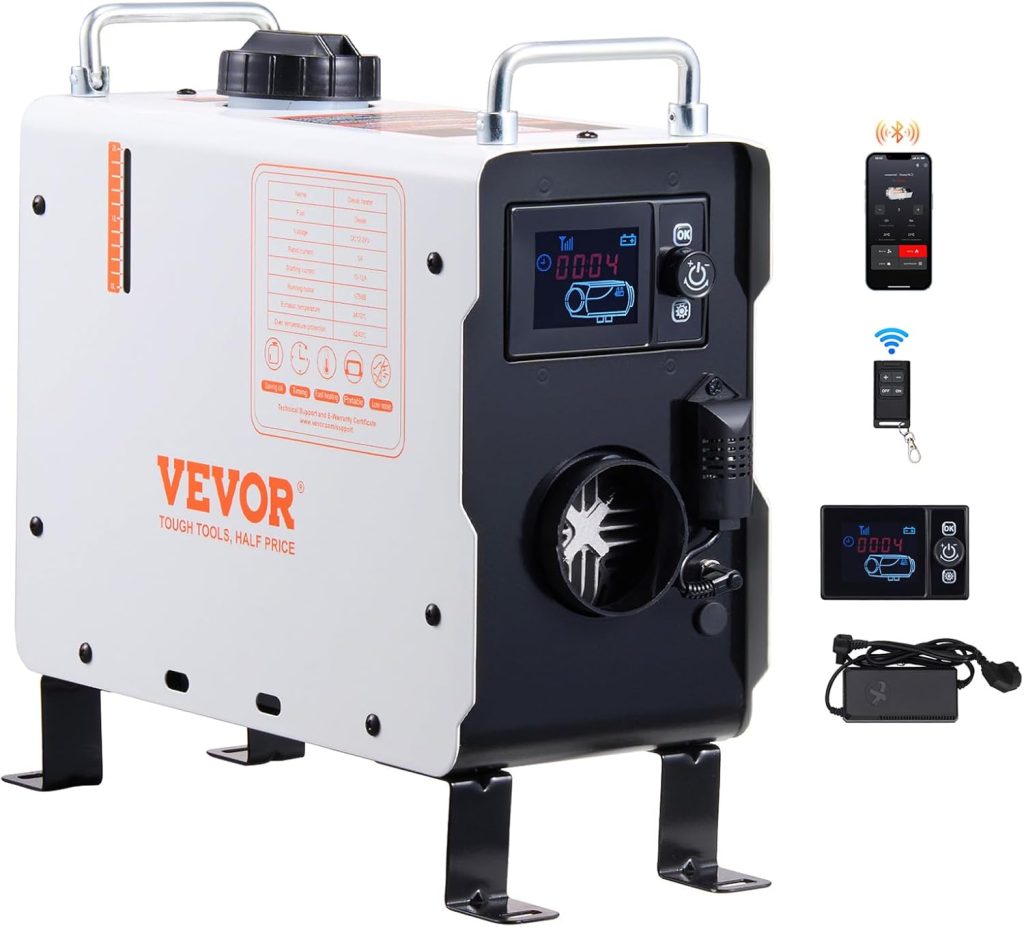
The smallest unit in the lineup. At 6,800 BTU, the 2KW is built for compact spaces: car cabins, small SUV cargo areas, and single-person tents. It also draws 12V DC power and consumes between 0.07 and 0.17 liters of diesel per hour. VEVOR sells a basic model with a wired LCD controller (ASIN: B084TNBPD2) and a newer all-in-one version with Bluetooth app control and a built-in CO alarm (ASIN: B0DKTKZJSG). The all-in-one also runs on both 12V and 24V systems.
A 10-liter external fuel tank on the basic model provides roughly 58 hours of runtime at the lowest setting. Meanwhile, the newer all-in-one version uses a smaller integrated tank.
VEVOR 2KW Diesel Heater
6,800 BTU | 0.07-0.17 L/h fuel consumption | 12V DC
Compact unit for SUV cargo areas, teardrop trailers, and single-person tents. Up to 58 hours runtime on 10L external tank at lowest setting.
VEVOR 5KW Diesel Heater
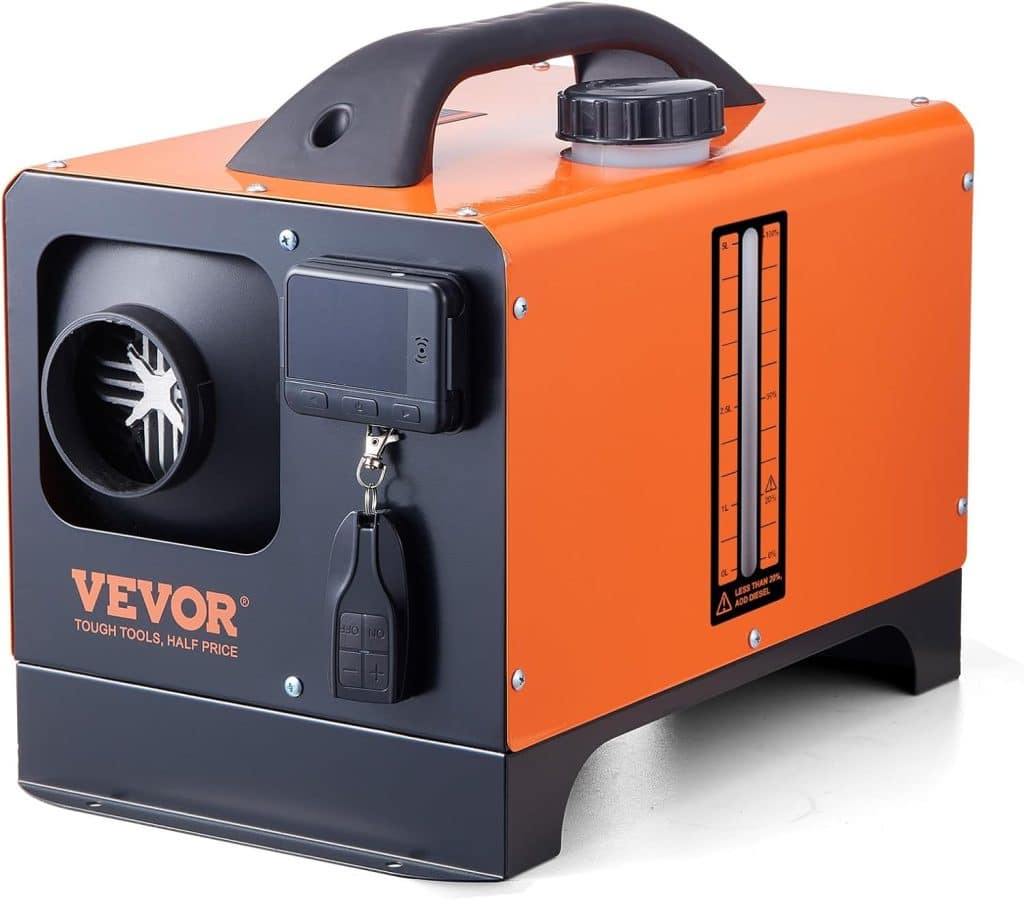
The mid-range option. At 17,000 BTU, the 5KW covers 161 to 215 square feet, which puts it in range for most camper vans, mid-size RVs, and large wall tents. Fuel consumption runs 0.16 to 0.52 L/h. Currently, the standard all-in-one model (ASIN: B0CFQRJQHW) ships with a 5-liter integrated fuel tank, LCD display, and remote control.
At the lowest heat setting, that 5-liter tank gets you roughly 8 to 10 hours of continuous heat. That is enough to get through a cold night without refueling, as long as you keep the heater off full blast.
VEVOR 5KW Diesel Heater
17,000 BTU | 0.16-0.52 L/h fuel consumption | 12V DC
Most popular size for camper vans, truck campers, and hot tents. Covers 161 to 215 sq ft. Includes LCD display and remote control.
VEVOR 8KW Diesel Heater
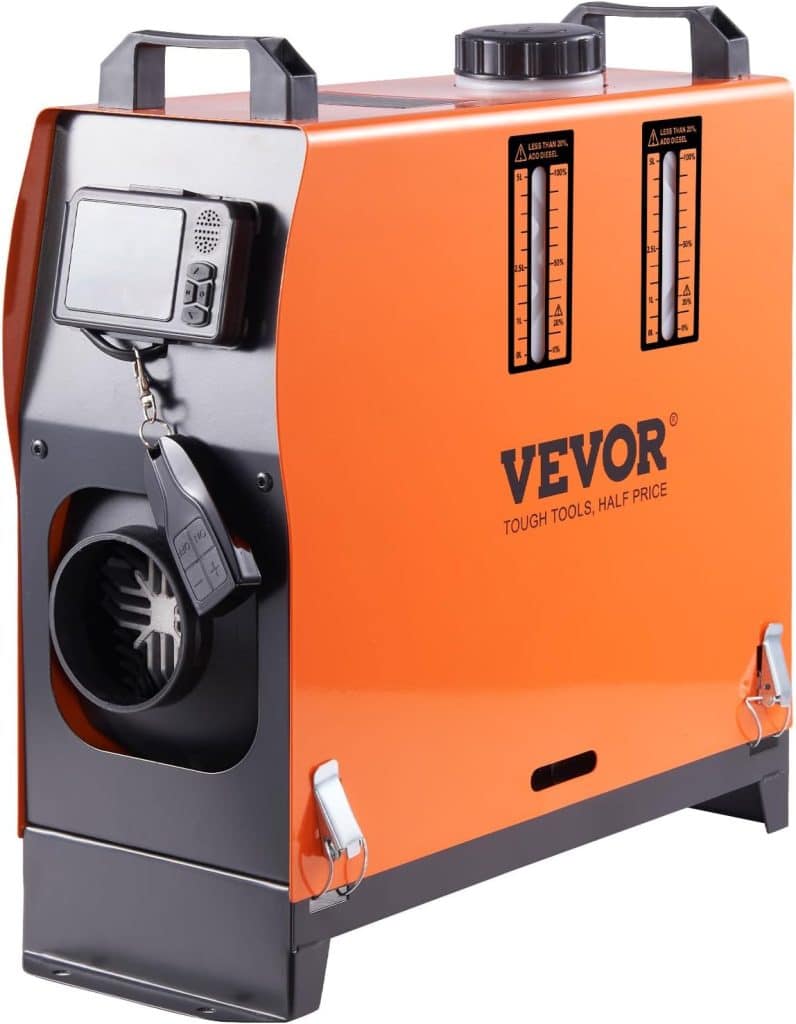
The largest consumer-grade VEVOR diesel heater. At 27,296 BTU, the 8KW model heats 215 to 269 square feet. It is built for full-size RVs, garages, workshops, and large canvas tents, while fuel consumption ranges from 0.18 to 0.67 L/h. VEVOR sells several 8KW configurations:
Options include the standard remote-control model (ASIN: B0CFQNS2R6) with LCD display, a Bluetooth-enabled model (ASIN: B0CFQR7H11) with app control and a larger feature set, and a separate non-all-in-one version (ASIN: B0CFQMRZMS) designed for permanent installation with external fuel lines and a separate fuel tank.
With a 10-liter fuel tank at the lowest heat setting, the 8KW model runs roughly 15 to 20 hours before needing a refuel. At full output, that drops to about 7.5 hours.
VEVOR 8KW Diesel Heater
27,296 BTU | 0.18-0.67 L/h fuel consumption | 12V DC
Largest VEVOR unit for full-size RVs, garages, workshops, and large wall tents. Covers 215 to 269 sq ft. Available with Bluetooth app control and automatic altitude adjustment.
Full Specs Comparison Table
| Spec | 2KW | 5KW | 8KW |
|---|---|---|---|
| BTU Output | 6,800 | 17,000 | 27,296 |
| Heating Area | Up to 107 sq ft | 161-215 sq ft | 215-269 sq ft |
| Fuel Consumption | 0.07-0.17 L/h | 0.16-0.52 L/h | 0.18-0.67 L/h |
| Voltage | 12V (some 12V/24V) | 12V | 12V (some 12V/24V) |
| Fuel Type | Diesel / Kerosene | Diesel / Kerosene | Diesel / Kerosene |
| Tank Size (All-in-One) | 5L integrated | 5L integrated | 5L integrated |
| Tank Size (Standard) | 10L external | 10L external | 10L external |
| Operating Temp Range | -40F to +122F | -40F to +122F | -40F to +122F |
| Control Options | LCD / Remote / Bluetooth (varies) | LCD / Remote | LCD / Remote / Bluetooth (varies) |
| Altitude Adjustment | Manual on some models | Manual on some models | Automatic on newer models |
| Approx. Price Range | $90-$150 | $130-$180 | $150-$250 |
How VEVOR Diesel Heaters Work
The Combustion Cycle
Every VEVOR diesel heater uses the same basic combustion system. A dose pump pulls diesel from the fuel tank and feeds it into a combustion chamber. Once inside, a glow plug ignites the fuel, then a fan blows air across a heat exchanger and pushes warm air into your space through a ducting outlet. Meanwhile, exhaust gases exit through a separate pipe that vents outside.
Power Draw and Battery Life
The heater draws 12V DC power from your vehicle battery, a portable lithium battery, or a dedicated deep-cycle battery. Startup current peaks at roughly 10 amps while the glow plug heats up, but once the heater reaches operating temperature, draw drops to 1 to 4 amps depending on fan speed and heat setting. On a 100Ah lithium battery, a 5KW VEVOR heater on low runs roughly 25 to 30 hours before it needs charging.
Temperature Control and Altitude
The thermostat controller (LCD panel or Bluetooth app, depending on your model) lets you set a target temperature. Based on that input, the heater cycles between high and low output to maintain that temperature. Some newer VEVOR models also include an automatic altitude adjustment feature on the 8KW unit, which modifies the fuel-to-air ratio for thinner air above 5,000 feet.
Which Size Do You Need?
2KW: Best for small enclosed spaces. If you sleep in the back of an SUV, a Tacoma with a canopy, or a compact teardrop trailer, the 2KW puts out enough heat without cooking you out of the space. It also draws the least power and burns the least fuel, so solo overlanders who prioritize battery life tend to land here.
5KW: The most popular size for camping and overlanding. This model covers the sweet spot for most setups: mid-size camper vans (Sprinter, Transit, ProMaster), truck campers, rooftop tent enclosures with a vestibule, and hot tents up to about 200 square feet. If you are unsure which size to pick, the 5KW is the safest bet because it runs at partial output for smaller spaces and still reaches full capacity for larger ones.
8KW: Built for big spaces and extreme cold. Full-size RVs, large wall tents, workshops, and garages need the 8KW to stay comfortable. If you camp regularly in sub-zero conditions, the extra headroom means the heater does not run at 100% output all night. As a result, that reduces wear and extends the life of the glow plug and fuel pump. The 8KW also makes sense for anyone heating a detached garage or shop during winter months.
One sizing mistake to avoid: buying too large for your space. If you put an 8KW heater in a small van, it will cycle on and off constantly, which creates more carbon buildup on the glow plug and shortens the heater’s lifespan. Match the heater to the space.
Common Problems and Troubleshooting
VEVOR diesel heaters are budget units, and owner forums and Amazon reviews surface the same recurring issues. Knowing about them before you buy helps you decide whether the trade-off is worth it and gives you a head start on fixes.
Error Code E-08 (Temperature Sensor Fault)
This is the most frequently reported issue across all VEVOR models. E-08 means the temperature sensor is reading incorrectly or has failed. Most of the time, the fix is a loose wire connection at the sensor plug, so check the wiring harness first. If the sensor itself is dead, replacements cost $5 to $10 on Amazon and take about 15 minutes to swap.
Carbon Buildup and Sooting
Running the heater on low settings for extended periods causes incomplete combustion, and carbon deposits build up on the glow plug and inside the combustion chamber. To prevent this, VEVOR recommends running the heater at full output for 15 to 20 minutes once a week to burn off residual carbon. If you skip this step, the heater will smoke on startup, misfire, or throw error codes.
Kinked or Poorly Routed Fuel Lines
Several owners report fuel delivery problems caused by the included fuel lines kinking during installation. Because the stock fuel line is thin-wall rubber, it bends too easily under pressure. Replacing it with braided automotive fuel line eliminates this issue entirely. Also, route the line with gradual bends and use zip ties to secure it away from heat sources.
Noisy Operation
The combustion fan and exhaust produce noticeable noise. VEVOR includes a muffler with most models, but some owners find it insufficient. Adding a second inline muffler to the exhaust reduces the sound to a low hum. On top of that, mounting the heater on rubber isolation pads also cuts vibration noise transmitted through the vehicle body.
Poor Documentation
The included instruction manual is machine-translated and missing critical details. Fortunately, the overlanding community on YouTube and Reddit has filled this gap with detailed installation walkthroughs. Budget 30 to 60 minutes watching install videos before you start the physical setup.
Setup and Installation Tips
All-in-One Models (Portable Setup)
The all-in-one models are the simplest to set up. Everything, including the heater, fuel tank, controller, and exhaust, is packaged in a single portable case. You fill the tank, connect the battery cables, run the exhaust hose outside, and turn it on. In total, setup time for an all-in-one unit is about 10 minutes.
Permanent-Mount Models
By comparison, permanent-mount models require significantly more work. You need to route fuel lines from the tank to the heater, mount the heater securely (bolted or strapped), run exhaust through the floor or wall with a heat-safe thimble, and wire the controller to a switched 12V circuit. Expect 2 to 4 hours for a clean permanent install depending on your vehicle.
Three Tips That Save Headaches
Prime the fuel line before the first start. Because the dose pump is small, it struggles to pull fuel through a dry line. Disconnect the fuel line at the heater end, run the pump until diesel flows, then reconnect. This prevents the glow plug from overheating during a dry start, which is the number one cause of early glow plug failure.
Use a dedicated fuel source. Tapping into your vehicle’s main fuel tank works for permanent installs, but most overlanders prefer a separate jerry can or integrated tank. Doing so keeps your driving fuel separate from your heating fuel and also makes tracking consumption easier.
Point the exhaust downwind and away from your sleeping area. Diesel exhaust contains carbon monoxide, so the exhaust pipe needs to terminate outside and away from any openings in your vehicle or tent. Use a CO detector inside your sleeping space as a non-negotiable safety layer. Our diesel heater maintenance guide covers long-term care in more detail.
VEVOR vs. Other Diesel Heater Brands
VEVOR occupies the budget tier. Here is how it stacks up against the brands overlanders compare it to most often.
VEVOR vs. Planar
Planar heaters are built in Russia with automotive-grade components. For example, a Planar 4kW portable unit costs $1,200+ and comes with an Espar fuel pump, metal construction, and a wired remote with silencer. The build quality difference is significant. Planar heaters run quieter, last longer, and handle altitude changes with factory calibration. Still, the VEVOR 5KW costs roughly one-tenth the price and delivers comparable heat output in a less durable package. We reviewed the Planar 4kW in our best diesel heaters guide.
VEVOR vs. Webasto/Espar
Webasto and Espar (now Eberspacher) are OEM suppliers for Mercedes, BMW, and commercial truck manufacturers. Their heaters cost $1,500 to $2,500+ installed, and these units are designed for hundreds of thousands of hours of operation with manufacturer warranties. Obviously, a VEVOR heater is not in the same class. If you need a permanent, set-it-and-forget-it heating solution for a daily-driven vehicle, Webasto and Espar are the standard. But if you need an affordable portable heater for weekend camping, VEVOR fills a different role.
VEVOR vs. HCALORY
HCALORY is another Chinese brand at a similar price point. The HCALORY Toolbox 2 uses a wider aluminum body for heat exchange and supports 12V, 24V, 110V, and 220V power inputs, which gives it more flexibility for home and garage use. Build quality between VEVOR and HCALORY is comparable, but HCALORY has slightly better documentation and a reputation for more consistent quality control. Even so, both brands have their share of DOA units.
VEVOR vs. Generic Chinese Diesel Heaters (CDH)
Search Amazon for “diesel heater” and you will find dozens of unbranded units priced between $60 and $120. VEVOR, however, sits a step above these in terms of brand accountability. You get an identifiable company with a customer service channel. With no-name CDH units, on the other hand, returns and warranty claims are hit or miss. The small layer of accountability is worth the $20 to $40 price premium VEVOR commands over generic units.
Frequently Asked Questions
Is a VEVOR diesel heater safe to use in a tent?
Yes, but only when installed correctly. Because the heater burns fuel in a sealed combustion chamber and exhausts outside, combustion gases do not enter your living space. Your main risk is a loose exhaust connection or a cracked heat exchanger, which is why a battery-powered CO detector inside the tent is mandatory. In fact, many overlanders use VEVOR heaters in canvas wall tents and hot tents with a properly routed exhaust pipe and report no issues.
How much power does a VEVOR diesel heater draw from the battery?
Startup draw peaks at 8 to 10 amps for about 2 minutes while the glow plug heats up. Once running, a 5KW model on low draws approximately 0.5 to 1.5 amps. On a 100Ah lithium battery (usable to 90%), the heater runs roughly 25 to 30 hours on low before the battery needs recharging. In contrast, running at full blast increases draw to 3 to 4 amps, which cuts runtime to 10 to 12 hours on the same battery.
Does a VEVOR diesel heater work at high altitude?
Standard VEVOR models struggle above 5,000 feet because thinner air changes the fuel-to-air ratio. As a result, the heater may smoke, misfire, or throw error codes at elevation. Newer 8KW Bluetooth models include automatic altitude adjustment. For older models, you need to manually adjust the fuel pump rate down to compensate. Some owners also install a potentiometer on the fuel pump to dial it in. Either way, expect performance degradation above 8,000 feet on non-altitude-adjusted models.
What fuel should you use in a VEVOR diesel heater?
Standard #2 diesel from any fuel station works. However, in cold weather below 20F, use winterized diesel or a 50/50 blend of #2 diesel and kerosene to prevent fuel gelling. Alternatively, kerosene alone also works and burns cleaner, which reduces carbon buildup. Do not use gasoline, biodiesel blends above B5, or waste vegetable oil.
How long does a VEVOR diesel heater glow plug last?
With proper use (regular high-output burn-offs and clean fuel), a VEVOR glow plug lasts 1 to 2 seasons of regular weekend use. Heavy daily use, on the other hand, shortens that to 3 to 6 months. Fortunately, replacement glow plugs cost $8 to $15 on Amazon and take about 20 minutes to replace. Because of this, keeping a spare in your kit is a good practice.
Are VEVOR diesel heaters loud?
On low settings, the combustion fan produces a steady hum in the 50 to 60 decibel range, similar to a household refrigerator. At full output, noise increases to 65 to 75 decibels. The included muffler helps, but adding a second muffler or an aftermarket silencer drops the volume noticeably. Placement matters too. Similarly, mounting the heater on rubber pads and keeping the exhaust exit away from reflective surfaces reduces perceived noise at your sleeping position.
Where is the best place to buy a VEVOR diesel heater?
Amazon offers the widest selection of VEVOR diesel heater models with Prime shipping and a straightforward return policy. VEVOR’s own website (vevor.com) sometimes runs lower prices, but return processing goes through VEVOR’s customer service rather than Amazon’s. Home Depot also carries select models for in-store pickup. Overall, for the easiest buying experience and return protection, Amazon is the most popular option among overlanders.
Related Articles
The Bottom Line
VEVOR diesel heaters fill a specific role: affordable, portable heat for campers, overlanders, and garage owners who want diesel-fired warmth without spending $1,000+. For most camping use, the 5KW model is the most versatile option. If you need to heat large spaces or camp in extreme cold, the 8KW suits those conditions well. The 2KW works for compact setups where power draw and fuel consumption matter most.
Build quality is below what you get from Planar, Webasto, or Espar. Because of that, expect to troubleshoot more, replace parts sooner, and spend time watching YouTube install guides instead of reading a clear manual. For weekend campers who enjoy tinkering and want a low-cost entry point into diesel heating, VEVOR delivers usable performance at a price point no other brand matches. But if you are a full-time van dweller or need absolute reliability, the premium brands remain the safer investment.
Every VEVOR diesel heater model listed in this article is available on Amazon with Prime shipping. We linked each unit above so you can compare current pricing, read owner reviews, and check which configurations are in stock.