


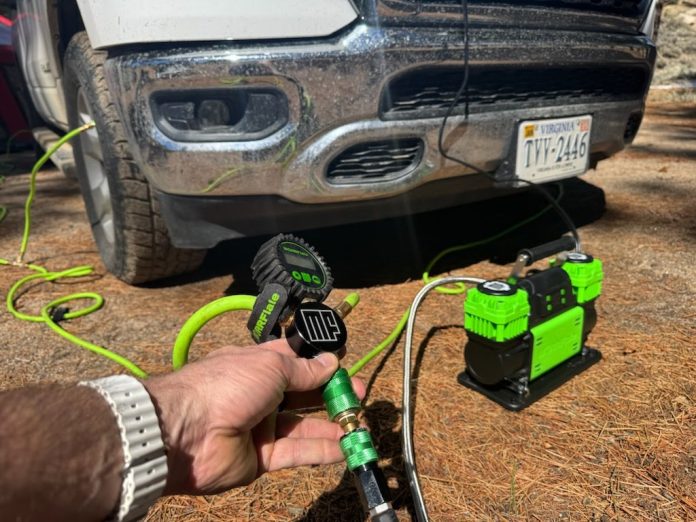

When you first start outfitting your off-road rig, choosing a compressor often feels simple: pick one, hook it up, and go. But once you’ve spent real days on trails airing down and back up, you begin to notice just how much difference your inflation setup makes. You may start wondering whether a single compressor is enough, or if there’s real value in doubling up with a parallel configuration.
This question isn’t just about redundancy. It’s about performance, heat management, duty cycles, inflation time, and how your compressor behaves under prolonged use. Is one strong compressor better than two smaller ones? When does adding a second compressor actually improve the experience?
In this article, we’ll walk through the science and practicality of parallel vs. single compressor setups, using the MORRFlate TenSix PSI Pro Gen 2 as a prime example of a high-performance unit that often shifts the equation in favor of a single, powerful setup.
Table of Contents
- Basic Concepts: Single vs. Parallel Compressor Setups
- Performance Differences: Airflow, Speed, and Efficiency
- Heat, Duty Cycles, and Long Sessions
- Redundancy and Reliability
- Installation and Power Considerations
- When Doubling Up Makes Sense
- The MORRFlate TenSix PSI Pro Gen 2 in Real-World Setups
- FAQ
Basic Concepts: Single vs. Parallel Compressor Setups

A single compressor setup means you’re relying on one unit to handle all your tire inflation needs. This is the default for most vehicles: a single-mounted pump powered by the vehicle’s electrical system and plumbed into a hose kit or onboard air tank. For many users, a single, capable compressor like the MORRFlate TenSix PSI Pro Gen 2 is more than enough, delivering high CFM, strong PSI control, and a duty cycle designed for repeated use on a single unit.
In contrast, a parallel compressor setup uses two compressors installed side-by-side, often feeding the same air manifold or tank. The idea is to double airflow potential and share workload. In theory, two compressors can combine their CFM and split the thermal load. In practice, however, benefits depend on the specific compressors, how they’re configured, and your real-world demands. A poorly matched pair can create electrical strain, imbalance in airflow, and unexpected heat buildup if they aren’t controlled properly.
Before we dive further, it’s worth noting that the term “parallel” is sometimes confused with “series” or “dual-stage.” In this context, parallel means two pumps operating independently but feeding a shared output. That’s different from compressors staged to build pressure in sequence. For most off-road tire inflation needs, parallel configurations aim to increase airflow and reduce inflation time, not necessarily increase ultimate PSI capacity.
Performance Differences: Airflow, Speed, and Efficiency

The primary metric people think about when comparing compressor setups is airflow, usually measured in CFM (cubic feet per minute). More airflow means more air moving into your tires per unit of time, which translates to faster inflation. A parallel setup with two matched units theoretically doubles your airflow, but the reality depends on how the compressors interact. Two small compressors may still be outperformed by one large, high-output unit.
For example, the MORRFlate TenSix PSI Pro Gen 2 delivers 10.6 CFM at 0 PSI and maintains strong airflow even under load. In many cases, that level of performance matches or exceeds what two lesser compressors can deliver in parallel when you factor in inefficiencies caused by coupling losses, mismatched duty cycles, and electrical limits. The benefit of a strong single unit is that it can deliver near its rated performance continuously without waiting for the second unit to kick in.
Speed is equally important. Two compressors that struggle to reach a given PSI individually may fight each other’s output when combined. In contrast, a single compressor designed for high airflow like the TenSix PSI Pro Gen 2 provides consistent, powerful airflow across the entire fill cycle. That means the first few PSI come up fast, and the compressor stays efficient even as pressure rises, which is crucial when inflating large 35″–40″ tires.
Heat, Duty Cycles, and Long Sessions

Running multiple compressors together isn’t just about airflow. It’s also about how heat builds and how long you can safely operate. Compressors generate heat when pumping air, particularly under high load or extended duty cycles. A compressor’s duty cycle rating—like the 80% at 0 PSI for the MORRFlate TenSix PSI Pro Gen 2—tells you how long you can run before it needs a break to cool down. Running two units doesn’t necessarily extend that cooling window if both are producing heat in the same confined space.
A single, high-capacity compressor that manages heat well often outperforms two smaller units that overheat more quickly. The Gen 2 upgrades on the TenSix, including aluminum cylinders, resized heat sinks, and a stainless steel outlet hose, help dissipate heat efficiently. That means sustained high output and fewer forced pauses for cool-down during group air-ups or multi-vehicle trips. In a parallel setup, both compressors may reach thermal limits at the same time, leading to simultaneous shutoffs that slow everything down.
Duty cycle isn’t just about preventing shutdown; it’s about longevity. Heat accelerates wear on seals, piston rings, and internal components. High-end compressors with thoughtful thermal design, like the TenSix, deliver consistent performance and protect themselves during long inflation sessions. Doubling up units with poor heat management doubles the heat problems instead of solving them.
Redundancy and Reliability

One argument in favor of parallel setups is redundancy: if one compressor fails, you still have another to fall back on. This can matter on long expeditions or in remote areas where replacement parts aren’t immediately available. However, redundancy doesn’t need two equal compressors. Many users pair a high-performance compressor with a smaller backup unit solely for emergencies, preserving airflow performance while providing a safety net.
Even with redundancy, it’s worth planning how the air delivery system works. Are both compressors feeding the same tank? Are they triggered independently? How are pressure sensors reading the combined output? These questions matter because parallel units that aren’t integrated intelligently can step on each other’s toes. The result is inconsistent performance or false pressure readings.
If redundancy is a priority, consider how the system will be managed electrically and pneumatically. A high-output unit like the TenSix PSI Pro Gen 2 can be your primary inflation source while a compact secondary compressor sits ready for emergencies. That approach delivers both performance during normal use and reliability when plans go sideways.

MORRFlate TenSix Off Road Air Compressor, 12 Volt Heavy Duty Tire Inflator
FAST 10.6 CFM INFLATION: Air up a set of 35″ tires in under 5 minutes when used with the MORRFlate multi-tire inflation and deflation kits.
- 10.6 CFM dual-cylinder output
- Fills four 35-inch tires in about 5 minutes
- Inflates and deflates four tires at once with the kit
- Overkill for a single daily driver staying on pavement
Installation and Power Considerations

Two compressors draw more current than one, which means you need to budget accordingly in your electrical system. Wiring, fusing, and power distribution must support both units safely. Undersized wiring can lead to voltage drop, reduced performance, and heating problems. It can also place undue stress on your vehicle’s electrical system. Parallel setups require careful planning to avoid these pitfalls.
A single, powerful compressor like the MORRFlate TenSix PSI Pro Gen 2 simplifies electrical planning. It draws ~50 amps while running and peaks around 90 amps. That’s significant, but manageable with properly sized wiring and a robust battery or dual-battery setup. Adding a second compressor could double your peak draw if both are running together, which may require heavier gauge wiring, relays, and fuse protection.
Physical installation also matters. Compressors generate heat and vibration, so mounting location affects performance and longevity. A single unit mounted in a ventilated compartment stays cooler and easier to service than two cramped together. Parallel setups need space, airflow, and access for maintenance. The TenSix PSI Pro Gen 2’s threaded filter caps mean it can be mounted in almost any orientation except upside down, which adds flexibility for complicated installs.
When Doubling Up Makes Sense

Doubling up compressors makes sense in a few specific scenarios. If you regularly air up multiple vehicles in a group setting, having a backup compressor ready can reduce wait times. If your trips take you far from civilization and you prioritize redundancy over airflow speed, a secondary unit can be a valuable fallback. If your primary compressor is spec’d for high PSI but lower CFM, a second unit designed for quick low-pressure airflow can supplement the system.
However, for most off-road tire inflation needs, one high-performance compressor that effectively feeds a multi-tire inflation system or onboard tank delivers a better balance of airflow, heat management, duty cycle, and simplicity. The MORRFlate TenSix PSI Pro Gen 2 often fills this role nicely because it was engineered for high output that isn’t bottlenecked by the common issues that plague smaller units in parallel.
Doubling up still makes sense in specialized builds. For example, if you’re running an air suspension, onboard air tools, and tire inflation all off the same compressor network, splitting loads between a primary unit and a secondary one dedicated to accessories can prevent your tire inflation compressor from being overworked. Just be mindful of how those units interact at the manifold and in your electrical system.
The MORRFlate TenSix PSI Pro Gen 2 in Real-World Setups
The MORRFlate TenSix PSI Pro Gen 2 is designed to handle real off-road inflation needs without doubling up. Its 10.6 CFM at 0 PSI, solid performance at 6.5 CFM under load, and intelligent Auto Mode (10–120 PSI) let you set target pressures and walk away while it does the work. Combined with a MORRFlate 4-tire inflation kit, it can air a set of 35″ tires from 10 to 40 PSI in about 5 minutes.
In many real-world scenarios, this performance matches or exceeds what paired smaller compressors deliver together. The key is that the TenSix maintains airflow throughout the fill. It doesn’t overheat prematurely and gives you a consistent experience on every trail. Thermal management features like the stainless steel outlet hose and aluminum components mean the duty cycle stays manageable even during repeated use.
Users who do double up often do so to pair the TenSix PSI Pro Gen 2 with smaller units dedicated to accessory air tools, not to increase tire inflation speed. That way, the high-output compressor focuses on keeping tire inflation fast and temperatures down, while the auxiliary compressor serves pneumatic jack systems, air hammers, or suspension adjustments without interfering with tire inflation performance.
MORRFlate TenSix Off Road Air Compressor, 12 Volt Heavy Duty Tire Inflator
FAST 10.6 CFM INFLATION: Air up a set of 35″ tires in under 5 minutes when used with the MORRFlate multi-tire inflation and deflation kits.
- 10.6 CFM dual-cylinder output
- Fills four 35-inch tires in about 5 minutes
- Inflates and deflates four tires at once with the kit
- Overkill for a single daily driver staying on pavement
FAQ

Do two compressors always double airflow?
No. Parallel airflow depends on how compressors are matched and plumbed. Mismatched units or improper manifolds can create restrictions that prevent actual combined airflow gains.
Does doubling up compressors improve duty cycle?
Not inherently. Each compressor has its own duty cycle. Unless they share workload intelligently, both can overheat around the same time.
Is a single high-output compressor better than two small ones?
Often yes, especially for tire inflation. A powerful unit like the TenSix PSI Pro Gen 2 delivers sustained airflow and better heat management than two lesser compressors working together.
Do parallel setups require special wiring?
Yes. Doubling up increases current draw, so wiring, fusing, and power distribution must support both compressors safely.
Can I use two identical compressors in parallel?
Yes. Matching units performs best, but manifold design and electrical support are still critical to ensure they operate efficiently together.
Does a strong compressor reduce inflation time?
Yes. Higher CFM at usable PSI speeds up inflation, especially when combined with multi-tire inflation systems.
Is compressor redundancy worth it?
It can be for remote trips or multi-vehicle use. However, for most purposes, a single high-performance unit with a well-designed setup offers better balance of speed, heat management, and reliability.
Just so you know, some of the cool stuff we mention comes with affiliate links, meaning we earn a commission if you buy (no extra charge to you!). Plus, we occasionally feature sponsored content, but rest assured, we only shout out products we genuinely stand behind.