


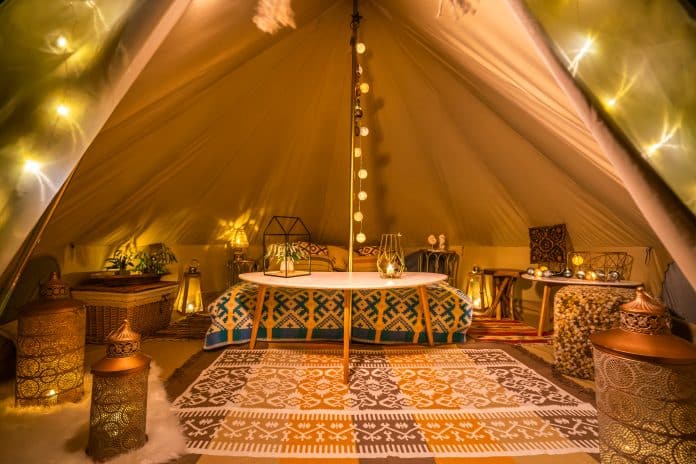

The Glamping Business Nobody’s Talking About: How Bell Tents Are Making People $50K a Year
Quick Verdict: A three-tent bell tent glamping operation costs $18,700 to $39,325 to launch and generates $43,800 to $72,120 in net revenue at 40% to 55% occupancy. Bell tents start at $875 per unit, making them 5x to 20x cheaper than glamping pods or yurts while commanding comparable nightly rates of $125 to $200. The glamping market is growing at 9.5% to 12.8% annually, and bell tents offer the fastest ROI of any glamping structure on the market. The trade-off: commercial tent lifespan runs 3 to 7 years, so you need quality canvas from the start.
Last updated: March 2026 | 10 min read
In This Article
- Bell Tent Glamping Overview: Who Is This Business For?
- Key Specs at a Glance: Bell Tent Business Fundamentals
- Real Income Numbers: What Bell Tent Operators Earn
- Startup Costs: The Full Breakdown
- Choosing the Right Bell Tent for Commercial Use
- Revenue Streams Most Operators Miss
- Zoning and Permits: The Step Most People Skip
- How to Hit $50K in Year One
- Bell Tents vs. Pods vs. Yurts: Which Structure Wins?
- Your First 90 Days: A Practical Timeline
- Pros and Cons of a Bell Tent Glamping Business
- Final Verdict
- Frequently Asked Questions
Bell Tent Glamping Overview: Who Is This Business For?
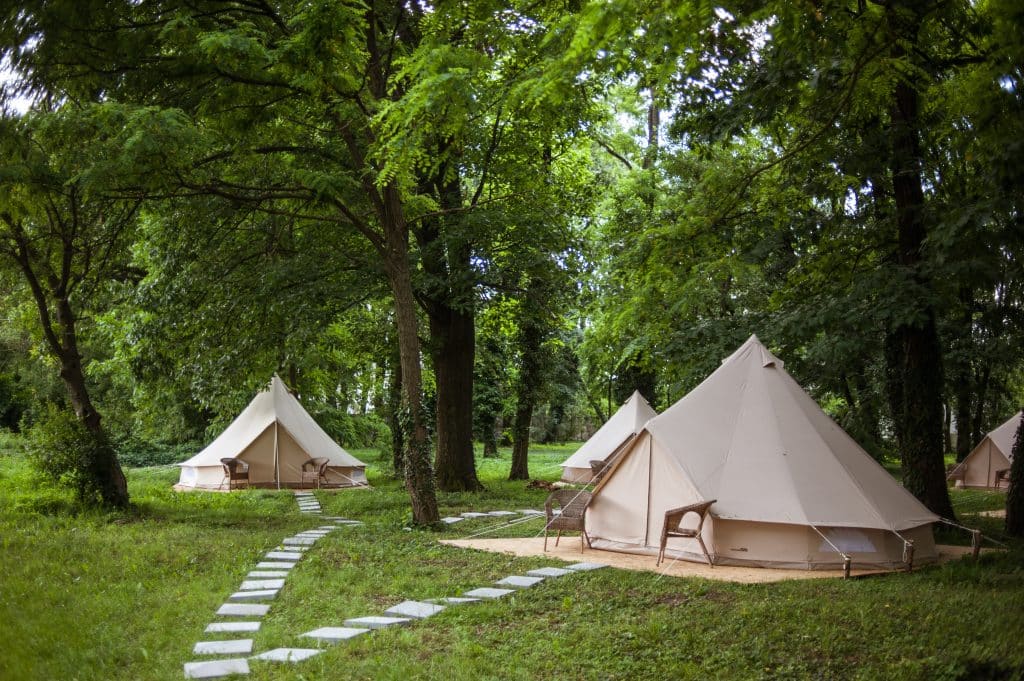
The glamping industry hit $4.2 billion in 2025. It is projected to surpass $10 billion by 2033. And while most startup guides focus on $200K lodge builds and luxury treehouse investments, a quieter segment of entrepreneurs is pulling $50,000 or more per year from a setup that costs less than a used car: canvas bell tents.
Specifically, this business model works best for landowners looking to monetize rural or semi-rural property, side-hustle operators who want passive income from a seasonal business, Airbnb hosts expanding into outdoor hospitality, and event rental operators adding overnight accommodations to their portfolio. In other words, you do not need hospitality experience. You need land, $19,000 to $40,000 in startup capital, and a willingness to treat this like a real business from day one.
Above all, bell tents are the lowest-cost glamping structure on the market. They command $125 to $200 per night on platforms like Airbnb, Hipcamp, and Glamping Hub. Meanwhile, that pricing is comparable to yurts and pods that cost 5x to 20x more upfront. The result: faster payback, higher margins, and lower risk if the market shifts.
Key Specs at a Glance: Bell Tent Business Fundamentals
| Metric | Details |
|---|---|
| Global Glamping Market (2025) | $4.2 billion, 9.5%-12.8% CAGR |
| Industry Average Nightly Rate | $251 ADR (U.S. Glamping Industry Report 2025) |
| Bell Tent Nightly Rate Range | $125 – $200/night |
| Bell Tent Unit Cost | $875 – $1,275 (quality canvas) |
| 3-Tent Startup Cost (All-In) | $18,700 – $39,325 |
| Year 1 Net Revenue (Conservative) | $43,800 (3 tents, 40% occupancy, $125/night) |
| Industry Profit Margins | 30% – 50% (established operations) |
| Realistic Occupancy Benchmark | 60% annually (well-marketed sites) |
| Commercial Tent Lifespan | 3 – 7 years (depending on canvas quality) |
| Recommended Tent Size (Glamping) | 16 ft (201 sq ft) to 20 ft (304 sq ft) |
Featured: Elk Mountain Tents
Yukon Bell Tents – From $875 (Free Shipping)
11 oz PolyShield canvas rated at 449 lbs breaking strength. Sizes from 13 ft to 20 ft. Every tent includes a zipped-in PVC floor, 4 screened windows, 4 peak vents, and a fiberglass stove jack. Family-owned in Nampa, Idaho for over 20 years.
Real Income Numbers: What Bell Tent Operators Earn
According to the 2025 U.S. Glamping Industry Report, the glamping industry averages $251 per night as an ADR (average daily rate) across all structure types. In comparison, bell tent operators typically price between $125 and $200 per night depending on location, amenities, and season.
Here is what a conservative three-tent operation looks like financially:
| Metric | Conservative | Moderate | Strong |
|---|---|---|---|
| Number of Tents | 3 | 3 | 5 |
| Avg. Nightly Rate | $125 | $150 | $175 |
| Annual Occupancy | 40% | 55% | 65% |
| Nights Booked (Total) | 438 | 601 | 1,186 |
| Gross Revenue | $54,750 | $90,150 | $207,550 |
| Operating Costs (20%) | $10,950 | $18,030 | $41,510 |
| Net Revenue | $43,800 | $72,120 | $166,040 |
Even the conservative scenario clears $43,800 in net revenue. Similarly, the moderate scenario generates over $72,100. To put this in context, industry data from Glampitect and Operto confirms established glamping operations achieve 30% to 50% profit margins, and 60% occupancy is a realistic benchmark for a well-marketed site.
Key Stat: A single bell tent generating $125/night at 55 nights per year produces $6,875 in gross revenue. A fully furnished setup pays for itself within the first season.
Startup Costs: The Full Breakdown
The biggest myth in the glamping business space is the idea you need six figures to get started. However, with bell tents, you do not. Below is a realistic cost breakdown for a three-tent operation:
Per-Tent Setup
| Item | Cost Range |
|---|---|
| Bell Tent (quality canvas, 16-20 ft) | $1,099 – $1,275 |
| Platform or Foundation | $2,000 – $5,000 |
| Furnishings (bed, linens, decor) | $1,000 – $1,500 |
| Lighting and Amenities | $300 – $500 |
| Total Per Tent | $4,400 – $7,775 |
One-Time Infrastructure
| Item | Cost Range |
|---|---|
| Site Prep and Grading | $2,000 – $5,000 |
| Permits and Licensing | $1,000 – $5,000 |
| Insurance (Annual) | $1,500 – $3,500 |
| Website and Listings | $500 – $1,000 |
| Initial Marketing | $500 – $1,500 |
| Total Infrastructure | $5,500 – $16,000 |
In total, startup for a three-tent site runs roughly $18,700 to $39,325. By contrast, a three-pod glamping site costs $80,000 to $150,000, and a three-yurt setup runs $40,000 to $100,000. Consequently, the math speaks for itself.
Choosing the Right Bell Tent for Commercial Use
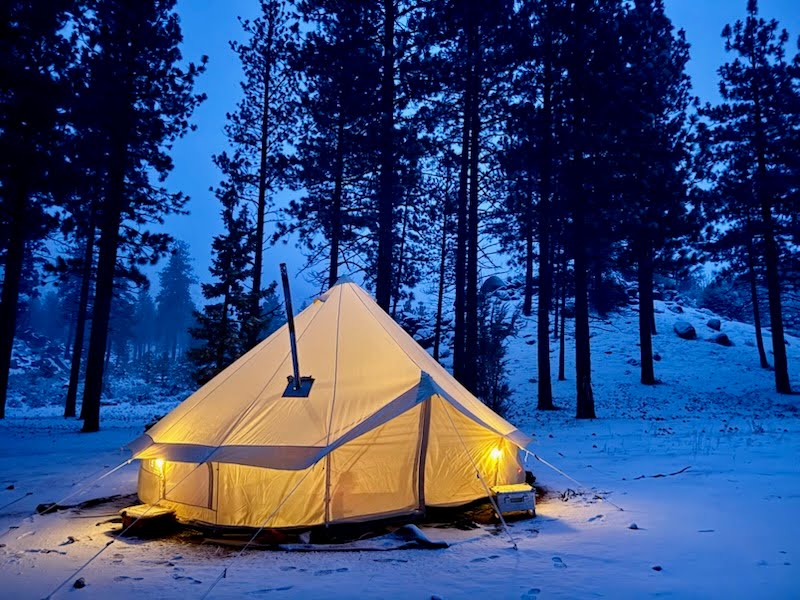
Not all bell tents are built for commercial use. The difference between a tent that lasts one season and one that holds up for years comes down to canvas quality, construction details, and features that matter to paying guests.
First, canvas weight is your most important filter. For instance, tents built with 11 oz polyester canvas, like the PolyShield material used by Elk Mountain Tents, offer tear strength of 67 lbs in the warp direction. That is roughly double what standard Sunforger-treated cotton canvas delivers. In addition, polyester canvas resists rot, mildew, and UV degradation better than cotton, which matters when your tents sit on platforms exposed to weather for months at a time.
I have personally tested Elk Mountain’s 16 ft and 20 ft Yukon Bell Tents along with their 13×16 wall tent with awning. All three performed extremely well across extended use. The 20 ft bell tent, at 304 sq ft of floor space, fits a queen bed, side tables, a small seating area, and still leaves room for guests to move comfortably. As a result, most successful glamping operators use the 20 ft size for couples’ retreats and romantic getaway listings.
Features That Matter for Guest-Facing Operations
Beyond canvas quality, focus on these features when selecting tents for your glamping business:
Zipped-in groundsheet. Elk Mountain includes a PVC 540g groundsheet that zips into the tent and curves 3.5 inches up the wall. This keeps water, insects, and debris out. Guests notice this immediately.
Screened windows and vents. The Yukon Bell Tent comes with 4 screened windows and 4 screened peak vents, all with mosquito netting. Ventilation keeps condensation down and guests comfortable in warm weather without sacrificing bug protection.
Stove jack. Every Elk Mountain tent includes an uncut fiberglass stove jack. As a result, you add a wood stove for fall and winter bookings, extending your season by 2 to 4 months in most climates. That extra season means $5,000 to $15,000 in additional revenue per tent.
Additionally, Elk Mountain sells wall tents in 13×13, 13×16, and 13×20 configurations, which work well as common areas, dining spaces, or event shelters alongside bell tent accommodations. For example, their 13×16 with awning ($2,050) creates a covered porch area that guests consistently photograph and post online. That kind of organic social media content is free marketing.
Scale Your Glamping Site
Elk Mountain Wall Tents – From $1,050
Add a wall tent as a common area, dining pavilion, or event space. The 13×16 wall tent with awning ($2,050) gives your guests a shared gathering space that photographs well and drives organic social media exposure. Same PolyShield canvas, same free shipping.
Revenue Streams Most Operators Miss
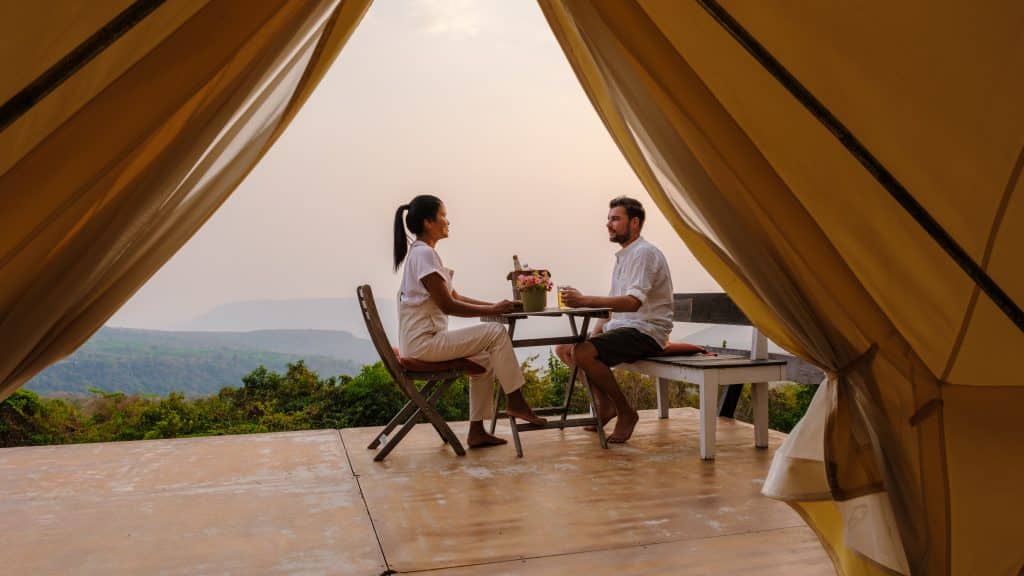
Nightly stays are the baseline income. However, smart operators build additional revenue streams on top of that foundation.
Wedding and event rentals. Bell tents rented for weddings command $200 to $500 per tent per event. A set of 5 tents at a single wedding generates $1,000 to $2,500 for one weekend. Some operators report booking 15 to 25 wedding events per season.
Experience packages. For example, adding a wood-fired hot tub ($40 to $90/night surcharge), a guided hike, or a farm-to-table breakfast basket turns a $150/night booking into a $220 to $275/night booking. Guests on Glamping Hub and Airbnb actively filter for properties with unique add-ons.
Corporate retreats. Similarly, companies pay premium rates for off-site team retreats. A 3 to 5 tent setup with a shared gathering space (a wall tent works perfectly here) books at $500 to $1,500 per night for the full site. As a bonus, weekday bookings fill the gaps leisure travelers leave empty.
Photography and content shoots. Because bell tents are photogenic, local photographers, influencers, and brands will pay $200 to $500 for a half-day shoot at your site. This also doubles as marketing when they tag your location.
Zoning and Permits: The Step Most People Skip
The number-one mistake new glamping operators make is buying or leasing land before confirming zoning allows commercial hospitality use. This step is not optional. It is the foundation your entire business rests on.
Therefore, contact your local Authority Having Jurisdiction (AHJ) before you sign a lease or purchase land. Ask specifically whether the property is zoned for transient lodging, which falls under Group R-1 Occupancy in the International Building Code.
In most cases, you will need a conditional use permit, building permits for each platform, a fire inspection, and ADA compliance for at least a portion of your units. Because of this, budget $1,000 to $5,000 and 2 to 6 months for approvals.
On the other hand, bell tents classify as temporary structures in most jurisdictions, which often means simpler permitting compared to permanent pods, cabins, or yurts. In fact, some counties allow temporary structures on agricultural or rural land with minimal permitting.
How to Hit $50K in Year One
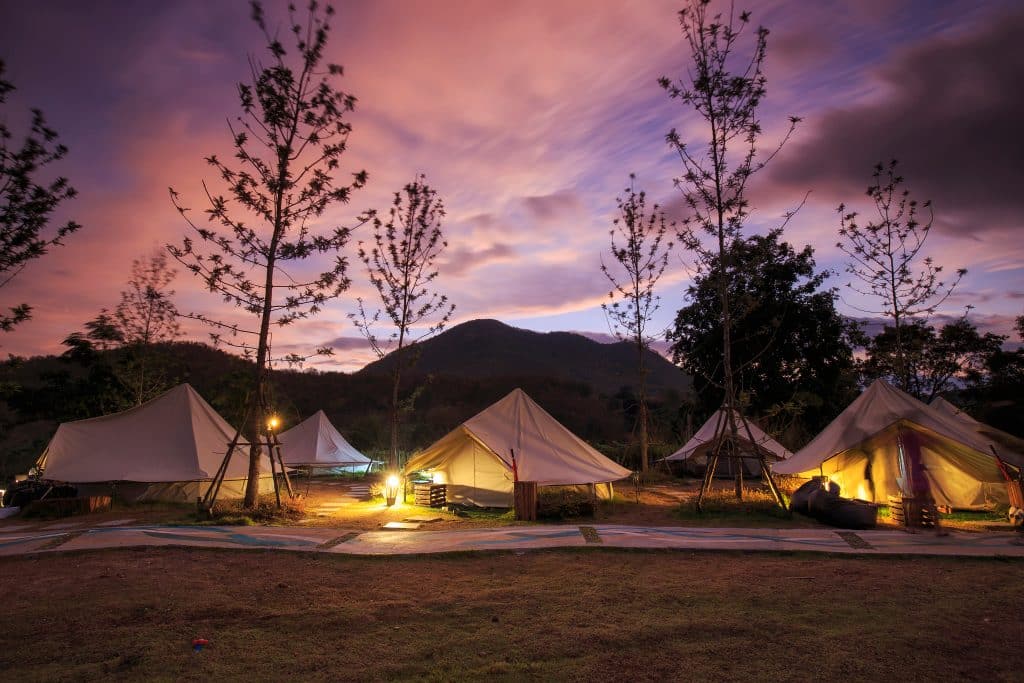
The path to $50,000 in your first year is straightforward. To begin, set your average nightly rate at $140. Then, achieve 40% occupancy across three tents. That gives you 438 booked nights for $61,320 in gross revenue. After 20% operating costs, you net $49,056. On top of that, add 5 to 10 event rentals at $1,000 to $2,500 each, and you clear $50,000.
Here are the keys to reaching 40% occupancy in year one: first, list on Airbnb, Hipcamp, and Glamping Hub simultaneously. Second, invest in professional photography because this single action drives more bookings than any other marketing spend. Third, price 15% below comparable listings for the first 60 days to generate reviews. Finally, respond to every inquiry within an hour.
Once you have 10 to 15 five-star reviews, raise your rates to market level. Ultimately, reviews are the currency of online hospitality. They matter more than your tent, your location, or your amenities.
Bell Tents vs. Pods vs. Yurts: Which Structure Wins?
Bell tents win on startup cost and ROI speed. For instance, a fully furnished bell tent setup runs $4,400 to $7,775 per unit. In contrast, a glamping pod runs $12,000 to $40,000 before furnishing, and a yurt starts at $8,000 and climbs past $30,000 for a luxury model. Despite this range, all three structures command similar nightly rates in the $125 to $300 range. As a result, the bell tent operator recoups their investment in one season, while the pod operator needs 2 to 4 years.
However, pods and yurts win on longevity. A well-built glamping pod lasts 20+ years. Meanwhile, a quality canvas bell tent in commercial rotation lasts 3 to 7 years depending on climate, maintenance, and canvas quality. Because of this, operators who choose bell tents should budget for tent replacement every 4 to 5 years and factor that into their long-term financial model.
For operators starting with limited capital who want the fastest path to cash flow, bell tents are the clear choice. On the other hand, operators with $100K+ in startup capital building a 10-year operation should give pods and yurts serious consideration. In practice, many successful sites use a mix: bell tents for sleeping accommodations and wall tents or pods for common areas.
Your First 90 Days: A Practical Timeline
Days 1 through 14: Research zoning. Contact your county’s planning department and confirm your land allows transient lodging. Begin the permit application.
Days 15 through 30: Order your tents. Elk Mountain ships within 24 to 72 hours via FedEx or UPS Ground with free shipping. While tents are in transit, build your platforms and plan site layout.
Days 31 through 45: Set up tents on platforms. Furnish each unit. Build shared facilities (fire pit, bathhouse access, parking).
Days 46 through 60: Hire a photographer. Create your Airbnb, Hipcamp, and Glamping Hub listings. Price at 15% below comparable listings to generate early reviews.
Days 61 through 90: Open for bookings. Focus on guest experience. Respond to every inquiry within an hour. Collect feedback and iterate.
Pros and Cons of a Bell Tent Glamping Business
Pros
- Lowest startup cost of any glamping structure ($875 – $1,275 per tent)
- Comparable nightly rates to pods and yurts ($125 – $200/night)
- Fastest ROI: single-tent payback in under 8 months
- Portable: relocate between sites or store off-season
- Stove jack enables fall/winter bookings ($5K – $15K extra revenue per tent)
- Simpler permitting as temporary structures in most jurisdictions
- Low operating costs (20% of revenue industry average)
- 30% – 50% profit margins achievable at 60% occupancy
Cons
- Commercial lifespan of 3 – 7 years (vs. 20+ for pods)
- Canvas requires maintenance: cleaning, re-proofing, mildew prevention
- Less insulation than hard-sided structures in extreme weather
- Seasonal income in northern climates without a wood stove setup
- Zoning and permits vary widely by county (2 – 6 months for approvals)
- Platform/foundation adds $2,000 – $5,000 per tent to startup costs
Final Verdict
The bell tent glamping business is the fastest, lowest-risk entry point into the $4.2 billion glamping market. If you have access to zoned land and $19,000 to $40,000 in capital, a three-tent operation puts you on track for $43,800 to $72,120 in year-one net revenue. Adding event rentals, experience packages, and corporate bookings pushes you past the $50,000 mark within your first operating season.
Of course, the real trade-off is durability. Canvas bell tents in commercial rotation last 3 to 7 years, not 20. Therefore, canvas quality is your single most important purchasing decision. Cheap tents that need replacing every season destroy your margins. Quality canvas from a manufacturer like Elk Mountain Tents, with 449 lbs breaking strength and 67 lbs tear strength on their PolyShield material, holds up to the demands of weekly guest turnover.
Alternatively, for anyone who wants a longer-lived structure, glamping pods ($12K – $40K per unit) or yurts ($8K – $30K) are worth considering. They cost more upfront but last longer. Even so, the smart play for most first-time operators is to start with bell tents to prove the concept, generate cash flow, and then reinvest into permanent structures as revenue allows.
The glamping market is growing at 9.5% to 12.8% CAGR. If you are going to start, start now. Research your zoning this week. Order your tents next. Have your first guests booked within 90 days.
Rating: 4.5 / 5 – Bell Tent Glamping as a Business Model
Ready to Launch Your Glamping Business?
Elk Mountain Tents – Bell Tents from $875, Wall Tents from $1,050
PolyShield canvas. 449 lbs breaking strength. Stove jack, zipped-in floor, screened windows on every tent. Ships within 24-72 hours. Free shipping. Family-owned, 20+ years in business.
Frequently Asked Questions About Starting a Bell Tent Glamping Business
How much does it cost to start a glamping business with bell tents?
A three-tent glamping operation costs between $18,700 and $39,325 to launch, including tents, platforms, furnishings, permits, insurance, and marketing. Bell tents are the lowest-cost glamping structure, with quality options starting at $875 per tent from manufacturers like Elk Mountain Tents.
How much money does a glamping business make per year?
A three-tent bell tent operation at 40% to 55% occupancy generates $43,800 to $72,120 per year in net revenue. Established operations with 5 or more tents and strong occupancy report $100,000 to $200,000 annually. Industry profit margins range from 30% to 50%.
How long does it take to make your money back on a glamping business?
A single bell tent setup ($4,400 to $7,775 fully furnished with platform) typically pays for itself within one season at conservative booking levels. Full operation payback for a three-tent site averages 12 to 18 months.
Do you need permits to start a glamping business?
Yes. Most jurisdictions require a conditional use permit, building permits, fire inspection, and proof of ADA compliance. Bell tents often qualify as temporary structures, which simplifies the permitting process compared to permanent structures like pods or cabins. Always verify zoning before investing.
What size bell tent is best for a glamping business?
The 16 ft and 20 ft sizes work best for couples and small family stays. A 16 ft bell tent (201 sq ft) fits a queen bed and basic furnishings comfortably. A 20 ft bell tent (304 sq ft) accommodates a queen bed, seating area, and side tables with room to spare. Most successful operators use the 20 ft size for premium listings.
How long do canvas bell tents last in commercial glamping use?
Commercial glamping operations that rotate guests weekly should expect 3 to 7 years depending on canvas quality, maintenance, and climate exposure. Polyester canvas (like Elk Mountain’s PolyShield) resists mildew and UV damage better than traditional cotton canvas, which extends lifespan in commercial settings. Recreational use extends lifespan to 10 to 20 years.