


If you’ve ever shopped for an off-road air compressor, you’ve probably seen duty cycle percentages proudly displayed near the top of the spec sheet. At a glance, those numbers seem simple: higher is better, lower is risky. But once you’re airing up tires at the trailhead—engine hot, sun overhead, friends waiting—it becomes clear that real-world performance doesn’t always match what the box promised.
Duty cycles are one of the most misunderstood specs in the off-road world. They’re technically accurate, yet often incomplete, and they rarely account for how compressors are actually used. That gap between theory and reality is where frustration, overheating, and premature failures tend to show up.
So, let’s break down what duty cycles really mean, why they’re often misinterpreted, and how to read between the lines when choosing a compressor. Along the way, we’ll use the MORRFlate TenSix PSI Pro Gen 2 as an example of how thoughtful design can bridge the gap between published ratings and real trail reliability.
Table of Contents
- What a Compressor Duty Cycle Actually Represents
- How Manufacturers Measure Duty Cycles
- Why Off-Road Conditions Change Everything
- Heat Buildup and Its Effect on Duty Cycles
- Load, Tire Size, and Extended Run Time
- Why Duty Cycles Don’t Predict Inflation Time
- Design Factors That Matter More Than Ratings
- Real-World Example: MORRFlate TenSix PSI Pro Gen 2
- Matching Duty Cycles to Your Use Case
- What to Look for Beyond Duty Cycles
- FAQ
- Reading Between the Spec Sheet Lines
What a Compressor Duty Cycle Actually Represents
At its core, a duty cycle describes how long a compressor can run within a specific time window before it needs to rest. A 50 percent duty cycle typically means 5 minutes on and 5 minutes off within a 10-minute period. A higher percentage suggests longer continuous operation, but only under the conditions used during testing.
This is where confusion starts. Duty cycles are not universal promises; they’re conditional statements. They assume a certain ambient temperature, a specific pressure range, and controlled airflow around the compressor. Change any of those variables, and the effective duty cycle changes with them.
For off-roaders, this matters because trail use almost never mirrors lab conditions. Understanding duty cycles as a guideline rather than a guarantee is the first step toward choosing the right compressor.
How Manufacturers Measure Duty Cycles

Most manufacturers test duty cycles in clean, controlled environments. Ambient temperatures are moderate, airflow is unrestricted, and the compressor isn’t competing with engine heat or dust. These tests provide consistency, but they don’t reflect trail reality.
Pressure also plays a role. Many duty cycles are measured at low or zero PSI, where compressors generate less heat and experience minimal resistance. As pressure climbs, internal temperatures rise, and that theoretical duty cycle becomes harder to maintain.
This doesn’t mean manufacturers are being misleading; it means consumers need context. A duty cycle rating is a baseline, not a prediction of how the compressor will behave after a long trail run.
Why Off-Road Conditions Change Everything

Off-road environments are harsh on air systems. Compressors are often used immediately after hours of low-speed driving, when engine bays and cargo areas are already heat-soaked. That starting temperature alone can reduce effective duty cycles.
Electrical conditions matter as well. Voltage drop from long wiring runs or aging batteries forces compressors to work harder, generating more heat in less time. Even a small drop in voltage can shorten usable run time.
Add dust, uneven terrain, and restricted airflow, and it becomes clear why duty cycles need to be evaluated through a real-world lens rather than a spec sheet.
Heat Buildup and Its Effect on Duty Cycles
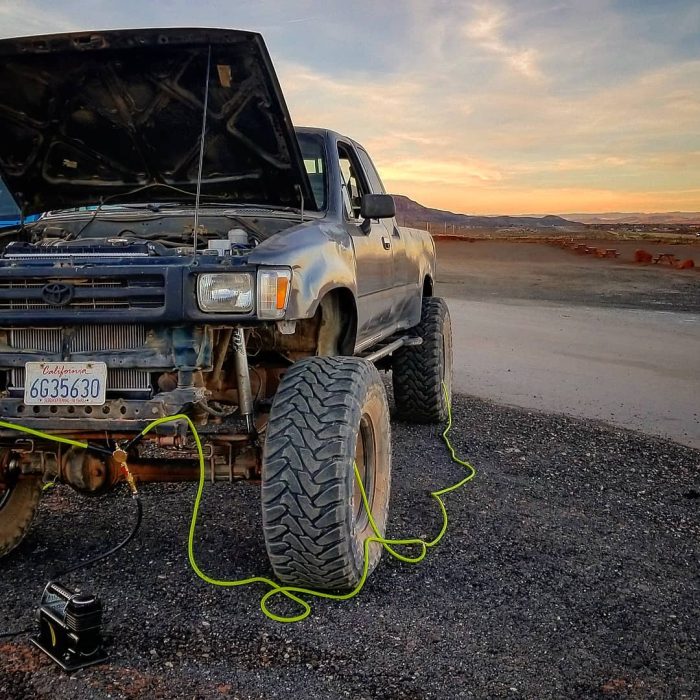
Heat is the primary limiting factor for most compressors. As internal temperatures rise, efficiency drops, seals wear faster, and motors experience greater stress. Duty cycles are ultimately a reflection of how well a compressor manages heat.
Thermal cutoff switches are often included to prevent catastrophic failure, but they don’t improve performance. They simply stop the compressor when temperatures become unsafe, often mid-air-up.
Compressors designed with better heat dissipation can maintain their rated duty cycles longer, even under sustained load. That difference becomes obvious during group air-ups or repeated use.
Load, Tire Size, and Extended Run Time

Larger tires dramatically increase air volume requirements. Airing up 35-inch tires from trail pressure to highway pressure takes far longer than many duty cycles imply.
Each additional minute of runtime compounds heat buildup. When compressors are pushed close to their limits, rated duty cycles shrink quickly.
This is why off-roaders often find that compressors with similar duty cycles perform very differently when faced with real tire sizes and real pressure ranges.
Why Duty Cycles Don’t Predict Inflation Time

Duty cycles describe how long a compressor can run, not how effectively it delivers air over time. As compressors heat up, CFM output often drops even before thermal protection kicks in.
This slowdown increases inflation time, even though the compressor hasn’t technically exceeded its duty cycle. In practice, that means waiting longer and generating more heat.
Efficient compressors maintain airflow deeper into their runtime, making duty cycles more usable rather than theoretical.
Design Factors That Matter More Than Ratings

Motor quality plays a significant role in real-world duty cycles. Dual-motor or dual-cylinder designs distribute load and reduce heat concentration.
Material choices matter as well. Aluminum cylinders and metal heat sinks dissipate heat more effectively than plastic components, extending usable run time.
Airflow management, internal tolerances, and electrical stability often matter more than the published duty cycle number.
Real-World Example: MORRFlate TenSix PSI Pro Gen 2

The MORRFlate TenSix PSI Pro Gen 2 isn’t just another air compressor with a hefty CFM number and a duty cycle percentage. It was designed from the ground up to address exactly the sort of real-world conditions that make duty cycles matter.
The unit uses a dual-cylinder layout that spreads mechanical load between two pistons rather than concentrating heat and friction in a single chamber. In practical terms, this means the compressor doesn’t develop the same hot spots you often see in cheap, single-cylinder designs; heat is generated more gradually and has more surface area to dissipate.
Those cylinders are machined from aluminum, which is not only lighter than mild steel but also conducts heat away from the compression chamber far more efficiently. This matters because the internal temperature of the piston chambers directly affects duty cycles: cooler chambers allow the compressor to run closer to its rated percentage for much longer. Compared to compressors that use plastic housings or steel cylinders with minimal heat sinking, the TenSix Gen 2 keeps its operating temperature lower for a sustained period.

Heat management continues beyond the cylinders themselves. The TenSix Gen 2 employs resized aluminum heat sinks (upgraded from ABS in earlier versions), which interface closely with the cylinder walls. These larger, better-fitting heat sinks draw heat out of the compression zone and dissipate it into the surrounding air more effectively. The unit also uses a stainless steel outlet hose, which not only resists corrosion but acts as its own thermal pathway; hot air moving through the hose loses heat to the metal walls instead of keeping all that heat next to sensitive internal components.
There’s also a thermal cutoff switch built into the TenSix that doesn’t just protect the compressor; it protects your duty cycle usage. When internal temperatures approach unsafe thresholds, the cutoff temporarily de-energizes the compressor to prevent damage. While this may sound like a shutdown, it actually preserves the long-term ability of the unit to run close to its rated duty cycle repeatedly over months and years of use, rather than degrading prematurely. In practice, you rarely hit this cutoff on normal tire inflation runs because the design’s combined heat management strategies diffuse heat faster than it accumulates.

On the user interface side, the TenSix PSI Pro Gen 2 features PSI Pro™ control board technology. This lets you set your target pressure (for example, 40 PSI on the road) and walk away while the compressor fills the tires automatically. In multi-tire inflation scenarios—where a MORRFlate 4-hose kit is used—this automatic control means the compressor cycles off as soon as the target is reached, minimizing unnecessary runtime and heat buildup. With a strong duty cycle rating (80% at 0 PSI), this system gives you usable run time without constantly babysitting the compressor, even when you’re airing up multiple vehicles or larger tire sizes.
Electrical design also impacts duty cycle performance. The TenSix PSI Pro Gen 2 runs on a robust 12V circuit, with a peak draw of around 90 amps and a typical running draw of near 50 amps. Solid wiring, quality connectors, and a stable electrical supply help maintain voltage under load, which keeps the compressor running efficiently rather than stressing the motor and generating excess heat. Cheaper units suffer from voltage sag that increases internal heat and shortens usable duty cycle in the field.
Across extended use—multiple air-ups during a day of trail riding, or inflating large 40″ tires—the TenSix PSI Pro Gen 2 rarely shows the kind of performance degradation or slowdown one expects from low-end compressors. The result isn’t just a good duty cycle percentage on paper; it’s a compressor you can depend on when conditions get tough, when ambient temperatures are high, and when you need to air up quickly without repeated cool-down periods.
Matching Duty Cycles to Your Use Case

A solo driver airing up once at the end of a trail has different needs than a group leader airing up multiple vehicles. Duty cycles should be evaluated based on how often and how long the compressor will be used.
Tire size, terrain, and climate all influence how demanding each air-up session will be. A compressor that feels adequate on paper may struggle in hotter or more demanding conditions. Choosing a compressor with headroom in its duty cycles provides flexibility and peace of mind.
What to Look for Beyond Duty Cycles

Build quality is a strong indicator of real-world reliability. Solid housings, quality wiring, and durable fittings support consistent performance when a compressor runs hard and often. These details may seem minor on a spec sheet, but they directly affect how well a compressor tolerates vibration, dust, and repeated heat cycles on the trail.
Thermal management features such as purge valves and oversized heat sinks improve long-term usability. By allowing internal pressure and heat to dissipate more efficiently, these components help prevent heat soak from compounding during back-to-back air-ups. Over time, better thermal control means the compressor maintains closer-to-ideal performance instead of gradually slowing down.
Manufacturers that share real-world performance data tend to design compressors with realistic duty cycles in mind. When brands acknowledge how their equipment is actually used—airing up multiple tires, running in hot environments, or supporting group trips—it usually translates into more honest ratings and better engineering choices. This transparency makes it easier for buyers to match a compressor to their real needs rather than relying solely on optimistic numbers.
FAQ
What is a realistic duty cycle for off-road use?
It depends on environment and load, but compressors designed for 80 percent or higher at low pressure tend to perform better under trail conditions.
Can a compressor exceed its rated duty cycle?
Briefly, yes, but doing so repeatedly accelerates wear and increases the risk of thermal shutdown or failure.
Why does my compressor shut off before finishing?
Thermal protection systems activate when internal temperatures exceed safe limits, often due to heat buildup or voltage drop.
Are duty cycles more important than CFM?
Both matter, but usable airflow over time is what determines real performance. Duty cycles and CFM must be considered together.
Heads up: Clicking on our affiliate links and exploring our sponsored content helps us at no extra cost to you, and we only recommend gear we’re absolutely crazy about!”